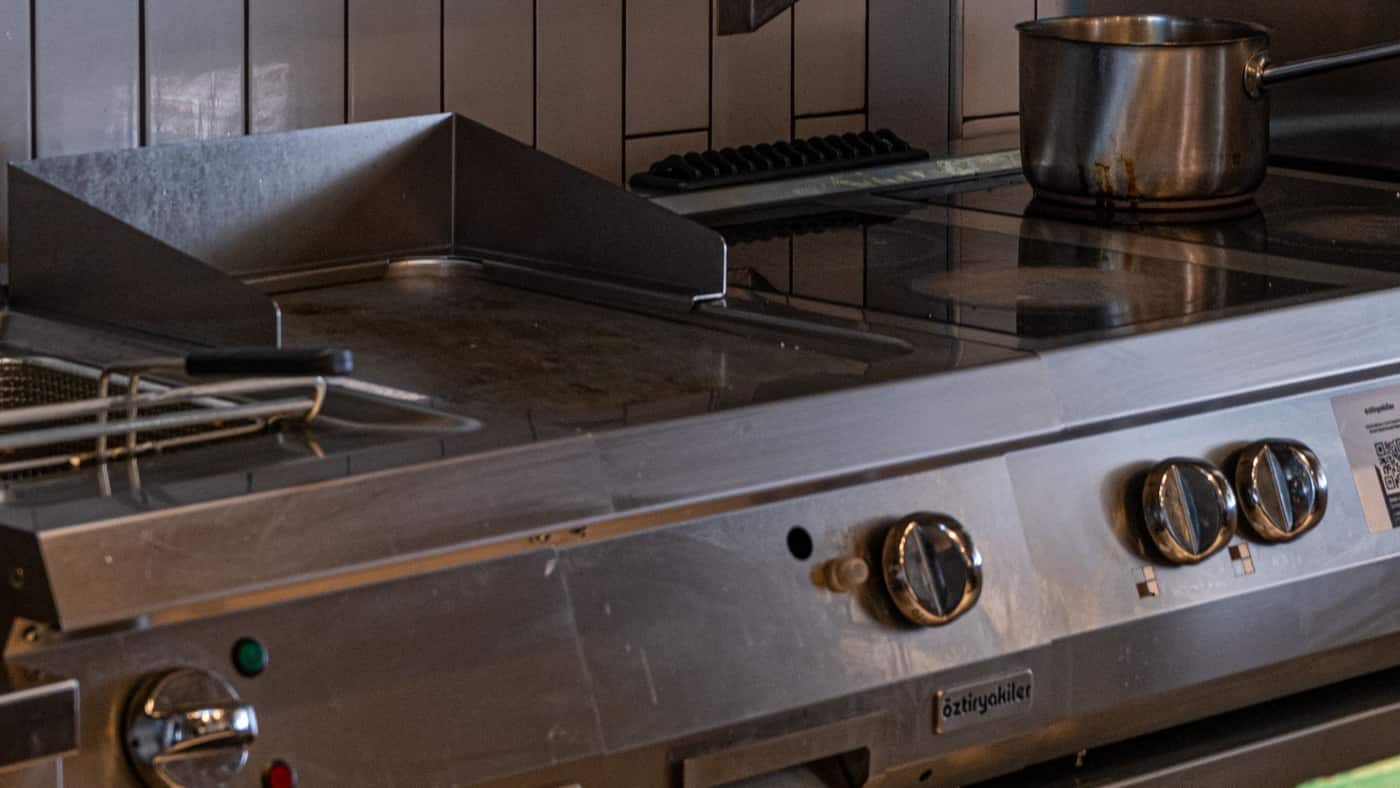
Commercial and restaurant equipment repair, by equipment type
Each page below covers one kind of equipment: how it works, how it fails, what an operator can check safely, and when repair stops making sense. We group them by what the equipment does in your kitchen or laundry, because that is how a problem usually shows up.
If you are not sure which page fits, start with the category overview at the top of each group. A symptom that spans several machines, such as a hot kitchen or a slow drain, is described there.
Whole kitchen 1
- Restaurant Equipment Repair
An independent commercial service company can repair most restaurant equipment regardless of brand, on site, because the failures follow the same systems: refrigeration, heat, water, gas and controls. On a whole-kitchen call you approve a written price for each repair before the technician starts it. Units under manufacturer warranty usually go through the factory network first.
Refrigeration 8
- Commercial Refrigeration Repair
Most refrigeration that will not hold temperature has one of a few causes: a dirty condenser that cannot shed heat, an iced evaporator that blocks airflow, a failed fan or start component, a leaking door gasket, or a refrigerant leak. Clean and airflow causes are cheapest to rule out first. Opening a sealed refrigerant system is regulated by federal law.
- Walk-In Cooler Repair
A walk-in cooler that drifts warm almost always traces to one of five things: an iced or dirty evaporator coil, a condensing unit starved of airflow, a door or gasket that lets humid air in, a failed evaporator fan, or a frozen drain line. Check the door and breaker first, then call.
- Walk-In Freezer Repair
Most walk-in freezer ice problems are defrost failures: a dead heater element, a termination thermostat that never closes, a stuck timer or controller, or a drain heater that stopped working. Ice also forms at the door when the frame heater or pressure relief port fails. Fixing the heater is the repair; chipping ice is only temporary.
- Commercial Refrigerator Repair
A reach-in that runs but stays warm usually has a clogged condenser coil, a failed evaporator or condenser fan, a worn door gasket, or a controller probe reading wrong. Less often a start component or a loss of refrigerant is the cause. Clean the condenser area and check the door seal before you call.
- Commercial Freezer Repair
A commercial freezer that frosts heavily and runs warm usually has a failed defrost heater, a bad defrost timer or termination switch, or a leaking door gasket feeding moisture to the coil. Chest freezers more often fail on lid seals and compressor start parts. The frost pattern on the coil tells us which.
- Prep Table Repair
A prep table rail runs warm when cold air cannot circulate under the pans. Causes include overfilled pans, open lids, a failed evaporator fan, a frosted coil, a dirty condenser, or a hot kitchen beyond the unit's ambient rating. The cabinet may be cold while the pans are not.
- Bar Cooler & Kegerator Repair
Foamy draft beer is usually a warm-beer problem: keg or faucet temperature above about 38°F, a tower or shank that warms the beer on its way out, or a cooler that cannot hold temperature. Wrong gas pressure and dirty lines also make foam. Check the cooler temperature first.
- Display Case & Merchandiser Repair
A display case that runs warm usually has a dirty or blocked condenser, a failed evaporator fan, a frosted coil from a defrost fault, or a worn door gasket. A thermostat or controller fault is the next suspect. Clear the condenser, check the gaskets, and call if the case still reads above 41°F.
Ice machines 1
- Ice Machine Repair
Most no-ice calls trace to a water supply problem, scale on the evaporator, a failed inlet valve, a dirty or blocked condenser, or a stuck bin control or water curtain. A machine that freezes but will not release has a harvest fault. Check the supply valve and condenser airflow first, then call.
Cooking equipment 15
- Commercial Cooking Equipment Repair
Cooking equipment that heats poorly usually has a supply problem, an ignition or element failure, or a control that has drifted. Low gas pressure, a weak spark module, a burned element, a failed high-limit or a thermostat reading off all produce the same symptom. A technician tests supply and controls before ordering parts.
- Commercial Oven Repair
On a gas oven the usual causes are a failed igniter or glow bar, a pilot or thermocouple fault, or a weak safety valve. On electric, look for a burned element, a failed contactor or a bad thermostat. A convection oven that cooks unevenly often has a failed blower motor or a door switch fault.
- Combi Oven Repair
A combi oven that will not make steam usually has a scaled steam generator or injection nozzle, a closed or clogged water supply, a failed water valve, or a humidity sensor that reads wrong. Hard water is the root cause on many service calls. Check the supply valve and any descale prompt before you call.
- Pizza Oven Repair
On a gas deck oven, the usual causes are a pilot or thermocouple fault, a failed safety valve, a clogged burner or a thermostat that no longer opens the valve. On an electric oven, look at the elements, contactor and thermostat. A strong draft or blocked flue can also keep a gas oven from holding heat.
- Conveyor Oven Repair
If the oven will not heat, look at the burner blower, air switch, igniter or elements and the thermostat. If the belt will not move, the drive motor, speed controller, drive chain or a jammed belt is likely. A tripped cooling fan thermostat can shut the oven down too.
- High-Speed Oven Repair
Cold centers and slow cook times on a rapid-cook oven usually mean the microwave side has lost power, most often a weak magnetron, or the impingement side is starved by a clogged air filter or failing blower. Each cause needs a different part, so the oven needs a diagnosis before anything is ordered.
- Commercial Range Repair
On a gas range, no light usually means a dead pilot, a clogged burner port, a failed thermocouple or safety valve, or a gas supply that has been shut. Electric ranges fail on a burned element, contactor or thermostat. Never relight a pilot you can smell gas around; leave and call the gas utility.
- Commercial Fryer Repair
Slow heat or poor recovery on a gas fryer usually comes from a weak thermopile or dirty pilot, a thermostat or temperature probe out of calibration, or a tripped high-limit. On electric fryers it is a failed element or contactor. The oil level, drain valve and burner tubes are checked first.
- Commercial Griddle Repair
Uneven griddle heat usually comes from a burner that has stopped lighting or is partly clogged, a thermostat bulb out of position or out of calibration, or a warped or scaled plate. Manual-control griddles also show hot spots when one burner valve is set differently. The plate is tested with a surface thermometer before any part is changed.
- Charbroiler & Salamander Repair
Uneven heat on a charbroiler usually comes from burners clogged with grease and carbon, cracked or collapsed radiants or lava rock, or a gas supply and air mixture that are off. Salamanders and cheesemelters lose heat from failed infrared burners or a stuck lift. The burners are cleaned and tested before parts are replaced.
- Commercial Steamer Repair
A steamer that will not make steam usually has scale on the generator or water level probes, a failed heating element or gas burner, a stuck fill valve or a door that is not sealing. Boilerless and connectionless models fail differently from boiler models. The unit should be descaled and tested before parts are replaced.
- Steam Kettle & Tilt Skillet Repair
On a self-contained kettle the usual causes are a tripped low-water cutoff from a jacket that has lost water, a failed burner ignition or heating element, or a bad thermostat. On a direct steam kettle, check the steam supply, strainer, regulator and trap. Jacket pressure work needs a technician.
- Commercial Microwave Repair
The cavity light, fan and turntable can run while the high-voltage side is dead. The usual causes are a failed magnetron, a shorted high-voltage diode or capacitor, a bad high-voltage transformer, or a tripped door interlock or monitor fuse. Those parts carry lethal voltage, so a technician must test and replace them.
- Food Warmer & Holding Cabinet Repair
Hot holding cabinets lose temperature from a failed heating element, a drifting thermostat or control, a worn door gasket, a dead circulation fan, or doors left open on a busy line. The FDA Food Code sets hot holding at 135°F or above, so a cabinet that cannot hold that temperature should be pulled from service.
- Bakery Equipment Repair
Uneven baking comes from a failed element or burner section, a thermostat or probe out of calibration, a dead circulation fan, a broken rack rotation, or steam that is not injecting. On rack ovens, check that the rack is turning. Gas burner and heat exchanger work is for a technician only.
Warewashing 3
- Commercial Dishwasher Repair
A machine that leaves dishes dirty or warm to the touch usually has low wash or rinse temperature, a failed booster heater, clogged spray arms or rinse nozzles, a worn wash pump, empty chemicals, or scale. Check the data plate for required temperatures. A machine that cannot sanitize must be shut down until repaired.
- Glasswasher Repair
Spots and film come from hard water minerals, a rinse aid pump that is not feeding, detergent that is too strong or too weak, a worn or clogged rinse arm, or a dirty tank. Beer and dairy protein film points to detergent dosing and rinse temperature. Descaling and chemical feed checks are the first fixes.
- Commercial Garbage Disposal Repair
A hum with no spin means something hard is wedged between the shredder ring and the swivel impellers, or the motor has lost a phase. A disposer that runs, then stops, is tripping its overload from a jam, low water flow or a failing motor. Lock out power before you clear anything.
Commercial laundry 3
- Commercial Laundry Equipment Repair
A commercial washer or dryer that stops working properly usually has a problem outside the drum: restricted venting, weak water pressure, a slow drain, low gas pressure, a lost phase of power or a payment system fault. A technician checks those supplies first, then the door lock, control board, motor and heating system.
- Commercial Washer Repair
A commercial washer that stops mid-cycle is usually waiting on a safety or a sensor: a door lock that did not engage, a drain valve that did not open, or an out-of-balance trip. Failed drive belts, a faulty inverter drive or worn bearings stop the spin. The control display or error code points to which one.
- Commercial Dryer Repair
A dryer that tumbles but does not heat usually has a gas burner that is not lighting: a failed igniter, flame sensor or gas valve coil. A dryer that heats but takes forever is almost always airflow: lint packed in the screen, a crushed or long exhaust run, or no make-up air. Both need a tech.
Hoods and ventilation 1
- Hood & Ventilation Service
The usual causes are an exhaust fan that has slowed or stopped, a slipping belt, loaded filters, or too little make-up air entering the room. A fan that turns backward after electrical work does it too. We find which one with airflow and amp readings, then repair the fan, belt, motor, filters or make-up air unit.
Food prep 2
- Commercial Mixer Repair
A mixer that will not start is usually waiting on an interlock: the bowl guard, the bowl lift position or a timer fault. If it starts but will not turn the beater, the gear transmission, a sheared drive component or a slipping belt is the cause. Speed changes on gear-driven mixers must be made only when it is stopped.
- Meat Slicer Repair
Uneven slices usually mean a dull or damaged blade, a gauge plate that is out of adjustment, or a carriage that has play. A slicer that will not start is typically held by an interlock, such as the blade guard, the sharpener or the thickness knob. Blade removal and replacement should be done only by a technician.
Beverage and frozen 2
- Commercial Coffee & Espresso Machine Repair
Cold or slow coffee usually means a failed heating element or thermostat, a scaled-up tank or a clogged sprayhead. No brew at all is often a closed water supply, a failed inlet valve or a tripped safety. On espresso machines, a worn pump, a group gasket or the pressurestat is the usual suspect.
- Soft Serve & Frozen Beverage Machine Repair
Product that is too soft or runny usually has a freezing cylinder that is not getting cold enough: a dirty condenser, a low mix level, a worn scraper blade or a refrigeration fault. Icy product points to the mix feed or the beater. A machine in a heat-treatment lockout will not serve until the cycle ends.
Programs 2
- Preventive Maintenance
A planned maintenance visit means cleaning, inspecting and testing equipment before it fails: condenser coils, door gaskets, water filters, descaling, thermostat calibration, burners, safety controls, drains and belts. The visit ends with a written list of anything that is worn or off spec so you can approve repairs on your schedule.
- Emergency Commercial Appliance Repair
Protect people and food before anything else. Smell gas or smoke: leave and call 911 or the gas utility from outside. Cold unit failing: keep doors closed, move product to working refrigeration, and log temperatures against the 41°F limit. Then call us any hour, any day, with the make, model and symptom. We answer emergency calls 24/7.