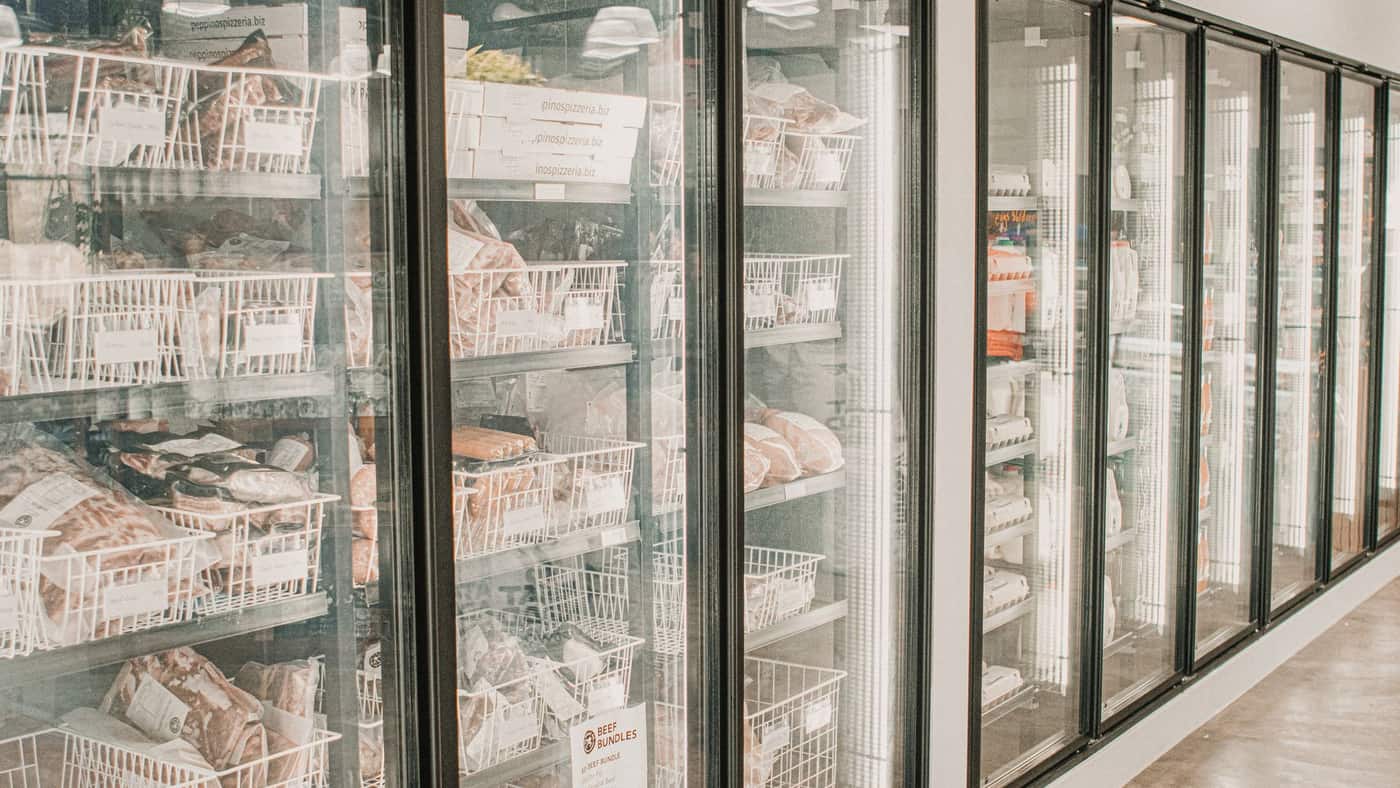
Walk-in cooler repair in Minneapolis and St. Paul
Walk-in cooler repair on site: evaporator coils, outdoor condensing units, door hardware and drain lines. Diagnosis and a written price before work starts.
Why is my walk-in cooler not holding temperature?
A walk-in cooler that drifts warm almost always traces to one of five things: an iced or dirty evaporator coil, a condensing unit starved of airflow, a door or gasket that lets humid air in, a failed evaporator fan, or a frozen drain line. Check the door and breaker first, then call.
About walk-in cooler repair
A walk-in cooler is an insulated box with a refrigeration system bolted to it, and most failures belong to one half or the other. The box side is panels, a door, hinges, a gasket, a sweep and a drain. The equipment side is a unit cooler hanging inside and, on most boxes, a remote condensing unit on the roof or an outside wall. When a cooler loses temperature, the first job is working out which half is at fault.
Coolers behave differently from freezers. The box holds roughly 35 to 38°F, so the coil defrosts itself every time the compressor cycles off and the room air melts the frost. That makes a cooler forgiving until something stops the off cycle: a door propped open, a fan that quit, or a drain that backed up. If your box is running at zero, you want walk-in freezer repair instead, where defrost is a heated process with its own failure points.
Kinds of walk-in coolers we repair
- Remote condensing unit with indoor unit cooler
The most common Twin Cities setup. The compressor sits outside, so winter low-ambient controls and summer condenser fouling both matter, and a refrigerant line set connects the two halves.
- Top-mount self-contained box
A small walk-in with the whole system on the roof of the box. Service is quicker to reach, but the condenser draws air from wherever the box sits, often a hot back hall.
- Rack-fed walk-in in a grocery or large kitchen
Fed from a shared compressor rack instead of its own unit. A box problem can be a rack problem, so the diagnosis starts at the liquid line and solenoid valve.
- Outdoor-installed box
Panels, door and roof see weather, snow load and sun. Gasket failures and water getting behind the insulation show up here first.
- Beer cave or floral cooler
A walk-in with a glass-door display wall, usually held colder for packaged beer. Glass doors and lights add heat load that a standard box does not carry.
Complaint, cause, correction
| Complaint | Likely cause | Correction |
|---|---|---|
| Box temperature creeping up through the afternoon | A dirty condenser coil or a tired condenser fan lets head pressure climb as the day warms, and the system loses capacity exactly when the kitchen is busiest. | Clean the condenser, test the fan motor and capacitor, and check pressures against the outdoor temperature rather than a fixed number. |
| Ice on the evaporator coil | In a cooler this means the off-cycle defrost is not happening. The usual causes are a door left ajar, a stuck defrost control, a failed fan, or a low charge dropping the coil below freezing. | Clear the ice with the unit off, then find why it formed. Melting it alone gives a few days of relief and the ice returns. |
| Water on the floor under the unit cooler | The condensate drain is plugged with slime or debris, the pan has cracked, or the line has lost its pitch or trap seal. Summer humidity in a busy kitchen makes a weak drain overflow quickly. | Flush the line, treat the pan, correct the slope, and confirm the trap holds water so warm room air does not travel up the drain. |
| Evaporator fans not turning | A seized fan motor, a blade rubbing ice, or a failed fan relay. The compressor runs, but the box air never moves across the coil, so the temperature climbs. | Replace the motor or relay and verify blade clearance and rotation direction. Reversed fans on a newly installed motor throw air the wrong way. |
| Condensing unit runs and shuts off on high pressure | A blocked condenser, a dead condenser fan motor, or leaves and cottonwood fluff packed into the outdoor coil. Snow drift against the unit does the same in January. | Clear airflow, clean the coil from the inside out, replace the fan motor if it is weak, and reset the pressure control only after the cause is gone. |
| Compressor runs but the coil stays warm | A refrigerant leak, a restricted filter drier in the liquid line, or a TXV that has stopped feeding. The box has no capacity even though everything sounds normal. | Leak-check, repair the leak, replace the drier and evacuate before recharging. Federal law limits opening a sealed refrigerant system to people holding EPA Section 608 certification, so this step is not a do-it-yourself fix. |
| Door will not seal or sweats along the frame | A sagging hinge, a torn gasket, a worn sweep, or a closer that has lost tension. Warm kitchen air enters, drops its moisture on the coil, and the box fights a constant load. | Re-hang the door, replace the gasket and sweep, adjust or replace the closer, and add strip curtains if the door stays open during service. |
| Cooler is dead or the unit will not start | A tripped breaker or disconnect, a failed contactor, a lost phase on three-phase units, or a pump-down solenoid that never opened. | The operator can check the breaker once. Anything beyond that is live 208/240 volt wiring, so stop and call. |
Check these before you call
- Look at the door. Make sure it closes and latches on its own, and that nothing is propping the gasket open.
- Check the breaker and the outdoor disconnect. Reset a tripped breaker once only; if it trips again, leave it off.
- Read the box thermostat or controller display and write down the temperature and the time you noticed.
- Look at the shelving. Product stacked against the unit cooler or to the ceiling blocks the fans' air return. Pull it back a few inches.
- Walk outside and look at the condensing unit. Clear leaves, snow, boxes or debris from around it without touching the coil.
Stop at gas valves, 208, 240 or 480 volt wiring, sealed refrigerant circuits, steam under pressure and anything live. Those are a call.
While it is down
Move the highest-risk product first: raw meat, dairy, cut produce and anything with a date label. Put it in a working reach-in, a neighbor's cooler, or a cooler with ice and a thermometer, and keep the walk-in door shut for the product still inside. Don't keep opening the door to check, because each opening dumps the cold you are trying to preserve. Log the temperature when you found it and when you moved product. When you call, tell us the box temperature, whether the compressor outside is running, and whether the evaporator fans inside are turning.
Upkeep that prevents the calls
- Clean the condenser coil on a regular schedule, and more often if the unit sits near a kitchen exhaust outlet or under trees.
- Wash the evaporator coil and flush the drain pan and line so slime does not build into a plug.
- Inspect the door gasket, sweep, hinges and closer. Replace worn parts before the seal visibly fails.
- Verify the evaporator fans and condenser fan are drawing normal current, and replace a motor that is running hot before it seizes.
- Check that low-ambient controls on the outdoor unit are working before the first hard freeze.
Repair or replace
A well-kept walk-in box lasts a long time, and the panels often outlive two or three refrigeration systems. The question is usually the equipment, not the box. A compressor failure on an old unit with a leaking coil, or repeated refrigerant leaks in buried line sets, can make a new condensing unit cheaper than a third repair. Wet, spongy panels or a rotted door frame is a different story, because insulation damage cannot be fixed with refrigeration parts. The repair or replace guide walks through the questions we ask, and we give you the diagnosis and a written price before any work starts.
Brands we repair
See also
Related repairs
Where it matters most
Where we repair walk-in coolers
- Walk-in cooler repair in Lino Lakes, MN
- Walk-in cooler repair in Maple Grove, MN
- Walk-in cooler repair in Maplewood, MN
- Walk-in cooler repair in Minneapolis, MN
- Walk-in cooler repair in Minnetonka, MN
- Walk-in cooler repair in New Brighton, MN
- Walk-in cooler repair in New Hope, MN
- Walk-in cooler repair in Oakdale, MN
- Walk-in cooler repair in Plymouth, MN
- Walk-in cooler repair in Prior Lake, MN
- Walk-in cooler repair in Ramsey, MN
- Walk-in cooler repair in Richfield, MN
More refrigeration repair
Walk-in cooler repair questions
Why does my walk-in cooler have ice on the coil if it is not a freezer?
A cooler should defrost itself on every off cycle. Ice means the off cycle is being cut short or the coil is colder than it should be. Door leaks, a defrost clock stuck in run, weak airflow and a low charge are the usual reasons.
Where do I measure the temperature of a walk-in cooler?
Measure product and air in the middle of the box, away from the door and the evaporator discharge. The wall display reads one probe. A calibrated thermometer in a bottle of water on a mid-height shelf tells you what your food is doing.
Will a walk-in cooler outside survive a Minnesota winter?
It will if the condensing unit has working low-ambient controls such as a fan cycle or head pressure control. Without them, cold outdoor air drops pressure too far and the liquid line starves the coil. Snow around the unit also blocks airflow.
Does a walk-in cooler need a heated floor or door frame?
Not normally. A cooler runs above freezing, so door frames and floors do not need heaters the way a freezer does. If you see heater wire on a cooler door, it is usually there for a glass-door display wall or a custom build.
Why is the ceiling of my walk-in cooler dripping?
Drips usually come from warm moist air condensing on the coldest surface it meets, often the unit cooler housing or a panel seam near a leaking door gasket. A cracked drain pan can also overflow into the box. Find where the air gets in.
Do strip curtains actually help in a walk-in cooler?
Yes, if the door opens often. They cut the air exchange every time someone walks in and out, which keeps coil load and frost down. They need to be kept clean and replaced when the strips go stiff or short.