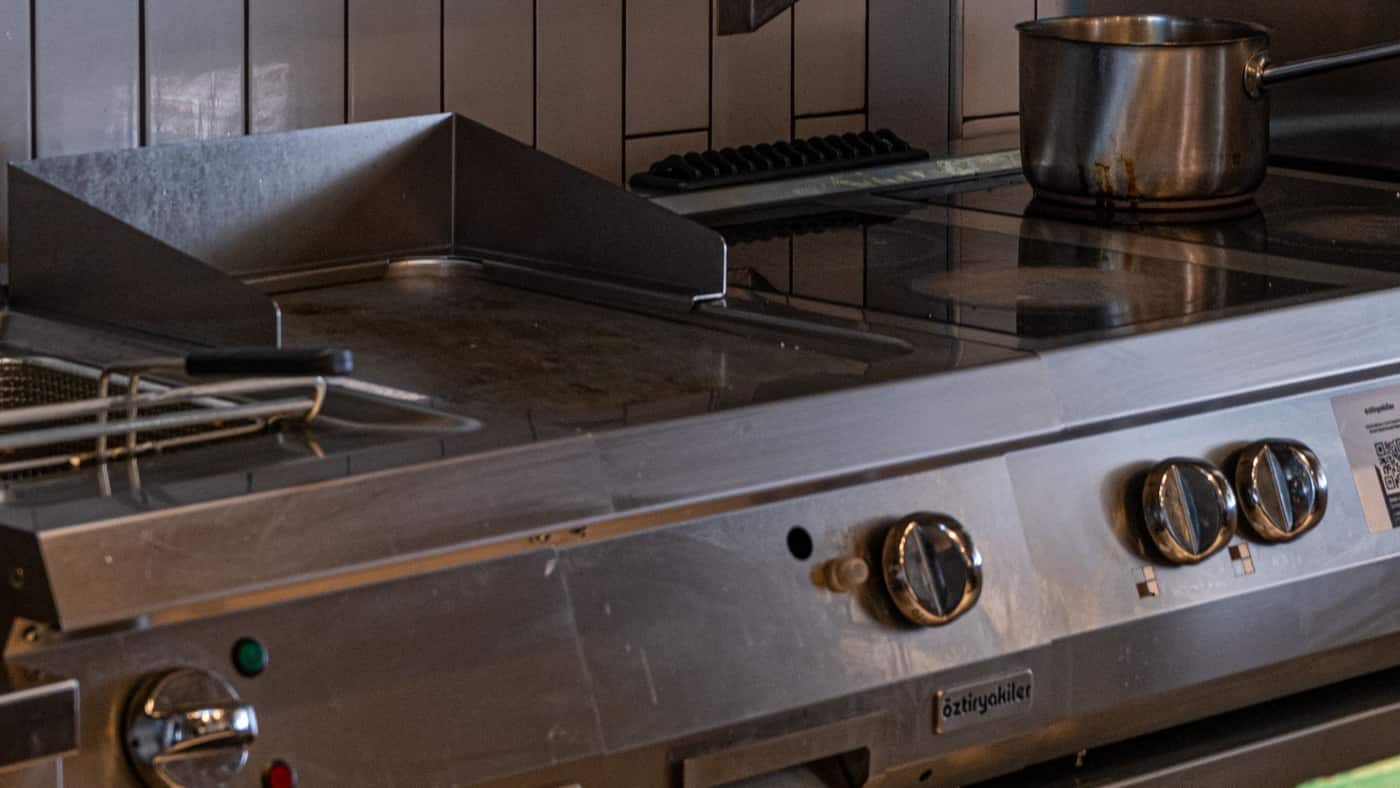
Commercial griddle repair in Minneapolis and St. Paul
On-site repair for commercial flat-top griddles: thermostats, burner zoning, thermostat bulbs, plate hot spots, grease troughs and safety pilots.
Why is my griddle cooking unevenly or not holding temperature?
Uneven griddle heat usually comes from a burner that has stopped lighting or is partly clogged, a thermostat bulb out of position or out of calibration, or a warped or scaled plate. Manual-control griddles also show hot spots when one burner valve is set differently. The plate is tested with a surface thermometer before any part is changed.
About griddle repair
A griddle is a flat steel plate with burners or elements underneath, and its quality depends on how evenly that plate holds a set temperature. A strip of cold steel along the front or a hot zone over one burner turns out eggs, pancakes and burger patties at different speeds on the same plate. The fault can sit in the burner, the control, the thermostat sensing bulb or the plate itself. A commercial range with a griddle section shares many of those parts but has its own controls.
We repair griddles on site, at your business. Gas valves, pilots and 208 or 240 volt wiring are technician work, the same as on a commercial fryer. Operators can do the safe checks: clearing the grease trough, confirming a burner knob is on and checking that a thermostat knob has not been bumped. Never reach under a hot plate, and never relight a pilot if you smell gas. Leave and call the gas utility or 911 from outside.
Kinds of griddles we repair
- Thermostatic gas griddle
A capillary bulb on the underside of the plate senses temperature and the thermostat modulates each burner or zone. Failures are bulbs that have shifted off the plate, thermostats out of calibration and burners that no longer ignite from the pilot.
- Manual-control gas griddle
Each burner has a valve with high and low settings and no thermostat. Cook quality depends on the operator, so uneven heat is usually a burner that has stopped lighting or a plugged port.
- Electric griddle
Elements under or inside the plate with thermostats or solid-state controls. Failures are burned elements, failed sensors and loose terminal connections.
- Chrome-plated or composition plate
Hard chrome plates resist sticking but crack or pit if cleaned with the wrong tools. A damaged plate surface sears unevenly even when the burner is working.
- Countertop and floor-model griddles
Countertop units use shorter plates and smaller burners, and floor models have a cabinet base. Both are serviced the same way; the difference is access to the burner area.
Complaint, cause, correction
| Complaint | Likely cause | Correction |
|---|---|---|
| A cold zone on part of the plate | One burner is not lighting, has a plugged port or has a pilot that is out. On a thermostatic griddle the thermostat bulb for that zone may also be off the plate. | Light and observe each burner, clean ports and pilots, reseat the bulb in its clip and replace the burner or pilot that fails. |
| The whole plate runs hot or cold compared with the dial | The thermostat is out of calibration or its capillary bulb is damaged. The control is reacting to a sensor that no longer reads the plate correctly. | Check actual surface temperature with a plate thermometer, recalibrate where the design allows and replace the thermostat if it will not hold. |
| Hot spot above one burner, cooler everywhere else | A burner running too rich, a burner shifted off its mounting or a warped plate that no longer sits flat against the heat. On manual griddles a valve left on high contributes. | Clean and set the burner air and gas, check the burner mounting and level the unit. A plate that is warped badly is replaced. |
| Pilot goes out or the safety valve drops out | A weak thermocouple, a dirty pilot or a draft from the hood pulling the flame. Grease dripping onto the pilot also puts it out. | Clean the pilot, test the thermocouple and replace what is weak. Gas valve work is a technician job. |
| Grease trough overflows or grease runs down the front | The trough or drawer is full, the trough outlet is blocked with burned grease, or the unit is out of level so grease runs the wrong way. | Empty and scrape the trough, clear the outlet and level the unit with the feet or legs. |
| Plate surface cracked, pitted or rough | Thermal shock from cold water on a hot plate, scraping with a coarse tool or long-term carbon buildup. | Season and clean with approved tools. A cracked or deeply pitted plate is replaced, because repair rarely holds under heat. |
| Electric griddle does not heat or heats in sections | A burned element, a failed thermostat, a loose terminal or a tripped limit. Each element zone is wired separately. | Meter each element and the control, replace the failed part and check terminals for heat damage. |
| Yellow flame or soot under the plate | Poor combustion air from a dirty burner or air shutter, a blocked flue or gas at the wrong pressure. | Clean and adjust the burner, check the flue and measure manifold pressure against the rating plate. |
Check these before you call
- Confirm the gas shutoff to the griddle is open and that the unit has not been moved off its connector.
- Check that burner knobs and thermostat dials are in the positions you expect and that nothing has bumped them while cleaning.
- Empty and clean the grease trough and drawer, because a full trough can smother a pilot or catch fire.
- Check the breaker on electric griddles, and the breaker feeding electronic controls on gas models.
- Lay a surface thermometer on several parts of the cold plate to see which zone is off. Write the readings down for the technician.
- Gas odor around a griddle burner means get everyone outside, then call the utility or 911 from there. Do not relight pilots.
Stop at gas valves, 208, 240 or 480 volt wiring, sealed refrigerant circuits, steam under pressure and anything live. Those are a call.
While it is down
When the griddle is down, a charbroiler or a flat pan on a working range burner can cover some items, and a commercial fryer may carry the breakfast or sandwich side of the menu. If only one zone is bad, hold the order of cooking so the plate's working sections carry the quicker items. Note which burners light, which do not and whether the pilot stays lit, and write down the model and serial number from the data plate. Do not scrape or clean a hot plate with cold water, and do not leave the grease trough full while the unit sits.
Upkeep that prevents the calls
- Scrape the plate and empty the grease trough every shift. Burned grease in the trough is a fire risk and blocks the outlet.
- Clean and season the plate on the manufacturer's schedule, and never use cold water on a hot plate.
- Check the thermostat calibration with a surface thermometer at a regular interval.
- Clean burner ports and pilot assemblies when the unit is cold, especially on a griddle that sees heavy breakfast service.
- Level the griddle so grease runs to the trough and the plate contacts the burner heat evenly.
- Have burners, thermostats and safety controls checked during a preventive maintenance visit.
Repair or replace
A griddle with a sound plate and frame is cheap to keep running: burners, thermostats, pilots and bulbs are all replaceable. The repair math changes when the plate is warped past flattening or cracked, when the cabinet and burner chamber are rusted, or when a control platform on a thermostatic unit is no longer available. A griddle that needs a new plate and a new set of controls in the same year is usually near the end of its service life. Our repair or replace guide lays out how to weigh that, and a written estimate gives you the repair side of the comparison.
Brands we repair
See also
Related repairs
Where it matters most
Where we repair griddles
- Griddle repair in Columbia Heights, MN
- Griddle repair in Coon Rapids, MN
- Griddle repair in Cottage Grove, MN
- Griddle repair in Crystal, MN
- Griddle repair in Eagan, MN
- Griddle repair in Eden Prairie, MN
- Griddle repair in Edina, MN
- Griddle repair in Elk River, MN
- Griddle repair in Farmington, MN
- Griddle repair in Forest Lake, MN
- Griddle repair in Fridley, MN
- Griddle repair in Golden Valley, MN
More cooking equipment repair
Griddle repair questions
Why does one side of my griddle cook faster than the other?
A burner on the slow side is probably not lighting, plugged or running low, or its thermostat bulb has slipped. Lay a surface thermometer across the plate to find the boundary, then have the burner and bulb for that zone tested.
What does a thermostat bulb do on a griddle?
The bulb is a sealed capillary sensor clipped to the underside of the plate. It expands as the plate heats and tells the thermostat when to cut gas. If the bulb slips out of its clip or the capillary is kinked, the plate runs hot or cold.
Can I use cold water to clean a hot griddle?
No. Cold water on a hot steel plate can warp or crack it and chrome surfaces can lift. Let the plate come down to a safe range and use the cleaning method and tools the maker specifies.
Why does my griddle fill the kitchen with smoke at normal temperatures?
Usually it is burned-on grease in the trough, drawer or under the plate, or an old seasoning layer that is carbonizing. Occasionally a thermostat reading low lets the plate run hotter than the dial. Clean the trough first, then check plate temperature.
Is a manual griddle harder to repair than a thermostatic one?
A manual griddle has fewer parts, so it is often simpler. The tradeoff is that it can hide uneven heat because there is no thermostat to react to it. Most repairs are burner cleaning, valve replacement and pilot work.
My griddle's flame is yellow under the plate. Is that dangerous?
A yellow flame means poor combustion and can deposit soot and produce carbon monoxide in the kitchen. Shut the unit down, keep the area ventilated and have a technician clean the burner and set the air mixture before further use.