Commercial dishwasher repair in Minneapolis and St. Paul
Commercial dishwasher repair in the Twin Cities: door-type, conveyor and undercounter machines, booster heaters, wash pumps, rinse arms and drains.
Why is my commercial dishwasher not cleaning or sanitizing?
A machine that leaves dishes dirty or warm to the touch usually has low wash or rinse temperature, a failed booster heater, clogged spray arms or rinse nozzles, a worn wash pump, empty chemicals, or scale. Check the data plate for required temperatures. A machine that cannot sanitize must be shut down until repaired.
About commercial dishwasher repair
A commercial dishwasher is the machine that fails an inspection when it fails. If the wash water is too cool, the final rinse is not hot enough or the chemical sanitizer pump has run dry, the dishes are not clean in the sense a health inspector means. Door-type, conveyor and undercounter machines share the same job but are built very differently. High-temperature machines sanitize with hot water; chemical machines sanitize with a sanitizer solution at a lower temperature. Knowing which type you have is the first step in any repair.
We repair commercial dishwashers on site and give you a written price before work starts. Your dish room is a bottleneck: when it stalls, the line runs out of plates and pans. Tell us the machine type, the make and model from the data plate, and what the thermometers on the machine read during a cycle. If the machine is draining badly, our guide on a commercial dishwasher not draining covers the common causes. For machines that wash only glassware at a bar, see glasswasher repair.
Kinds of commercial dishwashers we repair
- Door-type (hood-type, single-rack) machines
A rack is slid in, the hood is closed and a cycle runs. Door switches, hood counterbalance, the drain valve and the rinse solenoid are the repair points. Many are high-temperature models that need a booster heater.
- Conveyor machines (single- and multi-tank)
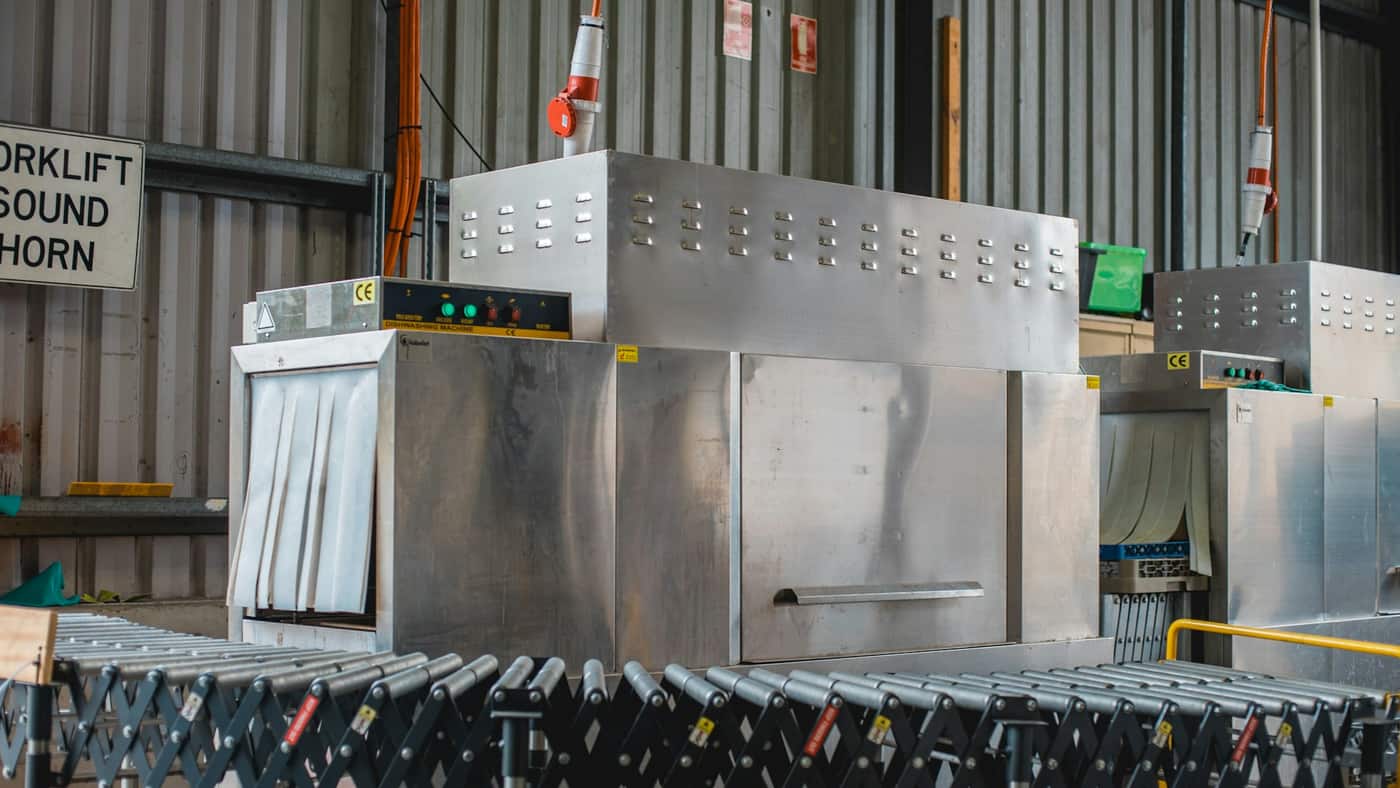
Racks ride on a powered conveyor through wash, power-rinse and final-rinse zones. Conveyor drives, curtains, tank heaters, multiple pumps and a rack sensor are all potential faults.
- Undercounter machines
Compact front-loading units common in smaller restaurants, bars and cafes. A single wash pump, an internal or external booster, a drain pump and the door switch carry most of the failures.
- High-temperature sanitizing machines
A hot final rinse sanitizes the dishes. A booster heater raises incoming hot water to the required final-rinse temperature. Booster elements, thermostats and pressure switches are the common faults.
- Chemical sanitizing (low-temperature) machines
A chemical pump meters a sanitizer, typically chlorine-based, into the final rinse at a lower water temperature. Peristaltic pump tubing, the injection fitting, and empty or incorrect product decide whether the machine sanitizes.
- Flight-type and rackless conveyors
Large pegged or flight-type machines for high volume operations such as hospitals and school kitchens. Chains, drive motors, tracking and the sensor controls are the main repair areas.
Complaint, cause, correction
| Complaint | Likely cause | Correction |
|---|---|---|
| Wash temperature too low | A failed tank heater element or thermostat, a tank that has not filled to the correct level, or incoming hot water supplied at too low a temperature. A scaled element heats poorly and eventually burns out. | The tank heater, thermostat and level control are tested against the data plate, and the supply hot water temperature is checked. A scaled tank is descaled before parts are replaced. |
| Final rinse never reaches sanitizing temperature | A failed booster heater element, a high-limit or thermostat that is open, a stuck flow or pressure switch, or a supply line that cannot feed enough hot water. | The booster is tested element by element, the switches and thermostat are checked and the rinse pressure is read at the gauge. Booster work involves high-amperage wiring and is for a technician only. |
| Dishes come out with food residue | A clogged or damaged spray arm, a plugged wash nozzle, a scrap tray not in place, a worn wash pump impeller, or an overloaded rack that blocks the spray. | Arms and nozzles are pulled and cleaned, the pump impeller and seal are checked, and the rack and scrap tray practice is reviewed. A worn pump is replaced rather than compensated with longer cycles. |
| Machine does not drain or leaves standing water | A clogged drain, a stuck drain valve or solenoid on a door-type machine, a failed drain pump on an undercounter unit, or a kinked or blocked drain hose. | Strainers and standpipes are cleared, the drain valve or pump is tested and replaced, and the drain connection to the floor sink is checked. Building drain lines are outside our scope. |
| White chalky film on dishes and machine surfaces | Hard water scale, a rinse aid pump that is not feeding, or a detergent concentration that is too low or too high. | The machine is descaled, the chemical feeds are checked and set, and the water supply and any softener or filtration are reviewed. Dosing is adjusted to your supplier's specifications. |
| Chemical sanitizer not feeding or reading low | An empty container, a worn peristaltic pump tube, an air lock in the line, a clogged injection fitting, or a pump that has failed. | Tubing and the pump are replaced, the line is primed, and the sanitizer concentration is verified with test strips against the label. A chemical machine that cannot reach the required concentration is not sanitizing. |
| Wash pump hums, leaks or trips | A worn pump seal, a seized or swollen impeller, a failed motor capacitor or bearings, or an overload from a jammed pump. | The seal, impeller and motor are inspected and replaced, and the pump is checked for something jammed in the housing. A pump leak that reaches the motor is a quick failure. |
| Door or hood will not close or the cycle will not start | A misaligned or failed door switch, a worn hood counterbalance, a broken rack guide, or an obstruction in the track. On conveyor machines a failed rack sensor or door interlock stops the drive. | The switches and linkages are adjusted or replaced and the door sequence is tested. Safety switches are never bypassed. |
| Conveyor stops or jerks | A worn drive chain or sprocket, a slipping clutch, a failed gearmotor, or a pawl and finger set that is worn out. A rack jammed against the curtain or exit rail also stalls it. | The drive is inspected, the clutch and chain are adjusted or replaced, and the pawls and rack path are checked. Overload protection that keeps tripping is a sign of a mechanical jam. |
Check these before you call
- Read the thermometers on the machine during a cycle and compare them to the data plate. The plate lists the wash and final rinse temperatures the machine requires.
- Check the incoming hot water, the breaker and the water supply valve. A closed valve or a tripped breaker is the most common cause of a machine that will not run.
- Make sure the scrap tray, strainers and wash arms are in place and not packed with debris. Pull the scrap tray and clean it between shifts.
- Check that the chemical containers are not empty and the pickup tubes reach the bottom. Test sanitizer concentration with the strips your supplier provides.
- If the machine leaks onto the floor, stop it and shut off the water. Do not remove panels on a machine with a booster heater; it carries high-amperage wiring.
Stop at gas valves, 208, 240 or 480 volt wiring, sealed refrigerant circuits, steam under pressure and anything live. Those are a call.
While it is down
A down dish machine is a production problem and a food-safety one. Switch to a three-compartment sink for wash, rinse and sanitize, and set it up the way your health inspector expects: soap, clean rinse water, and a sanitizer at the label concentration, checked with test strips. Stage dirty dishes so they do not stack up on the line, and cut menu items that use the most pans. Do not run a machine that fails to reach its required temperatures. Tell the technician the make, model, machine type, what the thermometers read during wash and rinse, and whether the machine leaks, hums or throws an error. That helps us bring the right parts and tools.
Upkeep that prevents the calls
- Delime the tank, heaters and rinse arms on a schedule set by your water hardness. Scale is the most common slow killer of heaters and nozzles.
- Pull and clean the wash arms, rinse arms and nozzles daily, and check that nothing is plugged. Drain and clean the machine at the end of every day.
- Check wash and final rinse temperatures at the start of every shift and log them. Chemical machines get sanitizer strips at the same time.
- Replace chemical pump tubing and injection fittings on a schedule instead of waiting for a failure, and keep chemicals from the same supplier as the dosing equipment.
- Have booster heaters, wash pumps, door switches and drain parts checked at scheduled visits; see preventive maintenance for how those visits are structured.
Repair or replace
A well-kept commercial dishwasher can run many years. Pumps, seals, heaters, solenoids, door switches and chemical pumps are normal repairs. The repair stops making sense when the tank has rusted through, when the frame or conveyor structure is damaged, or when the machine has repeated failures on the wiring and controls. An old machine may also use far more water and chemical than a newer one, which changes the true cost of keeping it. Check the manufacturer's warranty on a newer machine before paying for repairs. The repair or replace guide lays out how to compare the quote to a new machine.
Brands we repair
See also
Related repairs
Where it matters most
Where we repair commercial dishwashers
- Commercial dishwasher repair in St. Louis Park, MN
- Commercial dishwasher repair in West St. Paul, MN
- Commercial dishwasher repair in White Bear Lake, MN
- Commercial dishwasher repair in Woodbury, MN
- Commercial dishwasher repair in Andover, MN
- Commercial dishwasher repair in Apple Valley, MN
- Commercial dishwasher repair in Blaine, MN
- Commercial dishwasher repair in Bloomington, MN
- Commercial dishwasher repair in Brooklyn Center, MN
- Commercial dishwasher repair in Brooklyn Park, MN
- Commercial dishwasher repair in Burnsville, MN
- Commercial dishwasher repair in Champlin, MN
More warewashing repair
Commercial dishwasher repair questions
What temperatures does a high-temperature dish machine need?
The data plate on the machine lists them, and you should follow the plate. As a general reference, the FDA Food Code calls for a final sanitizing rinse of at least 180°F at the manifold on most hot-water machines, with the surface of the dishes reaching 160°F. Wash temperature minimums depend on the machine type.
How do I know if my machine is high-temperature or chemical?
Look at the data plate and the final rinse. A high-temperature machine has a booster heater and a final rinse thermometer showing around 180°F. A chemical machine has a sanitizer pump and a bottle of sanitizer feeding the rinse, and its rinse runs at a lower temperature. The plate states the sanitizing method.
What does a booster heater do?
It raises incoming hot water, often supplied at about 140°F, to the final-rinse temperature the machine needs. It is a separate electric water heater with elements, a thermostat and a high limit. If it fails, the wash may look normal but the final rinse is too cool to sanitize.
Why do my glasses and plates have a white film?
Most often it is hard water scale, a rinse aid pump that has stopped feeding, or the wrong detergent concentration. Scale also builds on the heater elements and plugs nozzles. Delime the machine, then have the chemical dosing checked against your supplier's settings.
My machine fills but the water will not drain. What is wrong?
On a door-type machine, the usual cause is a stuck drain valve or solenoid, or a clogged strainer. On an undercounter machine it is often a failed drain pump or a kinked hose. Clearing food from the scrap tray and standpipe is a safe first step.
Can I use any detergent in my machine?
Use the detergent, rinse aid and sanitizer your chemical supplier specifies for your machine type and water. Chemical pumps are set for specific products and concentrations. A mismatch causes foam, film and poor results, and wrong chlorine levels can corrode components.