
Commercial cooking equipment repair in Minneapolis and St. Paul
Commercial cooking equipment repair in Minneapolis and St. Paul: ovens, ranges, fryers and steam, and how a line's layout shapes each repair.
How does where an appliance sits on the line change its repair?
Position decides heat, air and access. An appliance beside a fryer or under a salamander takes radiant heat on its controls, one near the make-up air jet can have flames pushed around, and one shoved against the wall may need pulling out, with its gas connector and restraint reconnected, before a part can be reached.
How a commercial cooking equipment fails and gets repaired
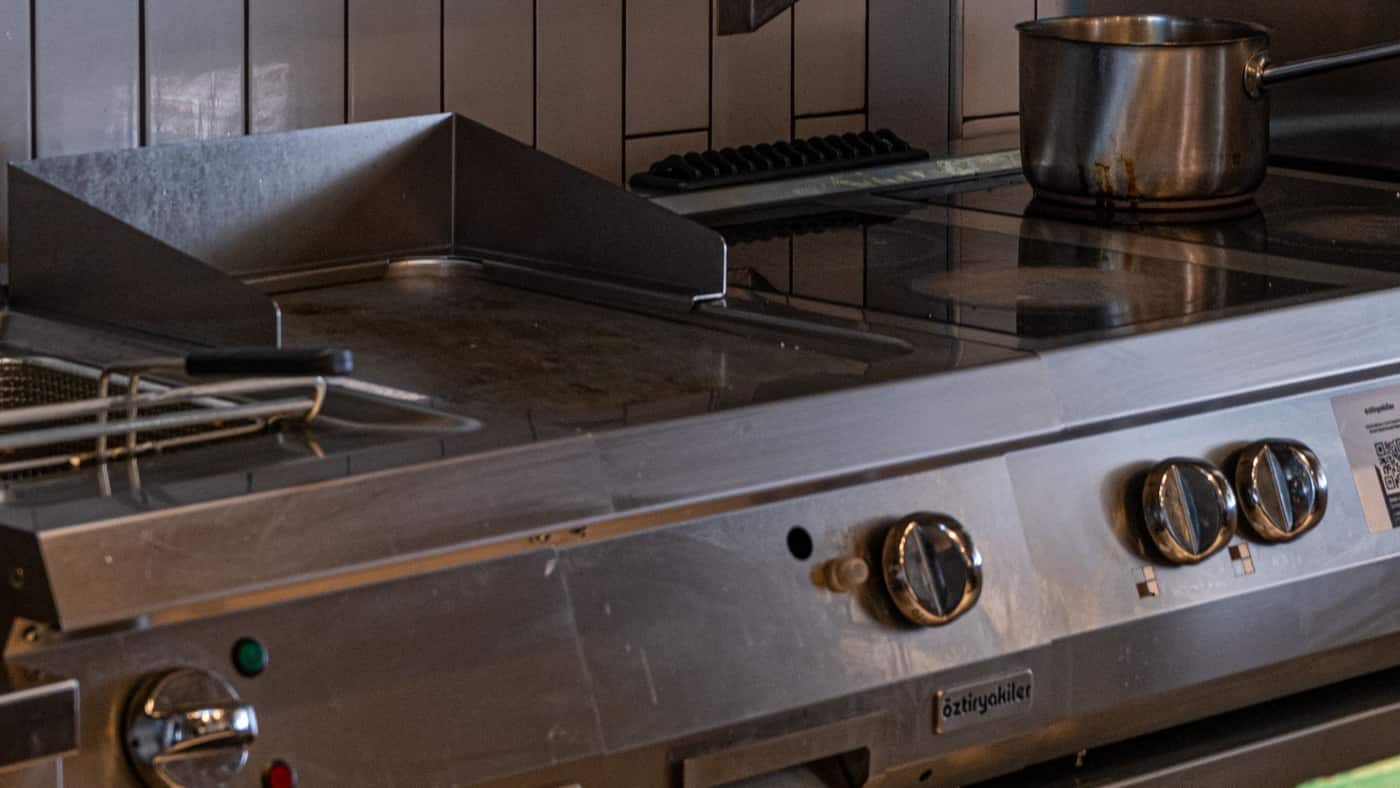
A cooking line is a row of appliances in a fixed order under one hood, and the order matters: the charbroiler sits next to the fryer, the range under the exhaust, the salamander above the burners. Each position puts a different load of heat, grease and moving air on whatever stands there. Each appliance has its own page for its own parts, for example commercial oven repair and griddle repair.
Gas odor at any cooking appliance is a utility call, made by someone who has already left the kitchen. If a unit trips its breaker again or shows a burning smell, switch it off and call. The appliance itself is the repair: burners, ignition, thermostats, elements, valves, controls and wiring. Fire suppression and hood and duct grease cleaning are separate trades, and the exhaust side is covered by our hood and ventilation service.
Commercial cooking equipment we repair, by type
- Ovens
Pick the oven page by how it makes heat: commercial oven repair, combi oven repair, pizza oven repair, conveyor oven repair or high-speed oven repair.
- Open-flame and flat-top cooking
Choose by the cooking surface: commercial range repair, griddle repair or charbroiler and salamander repair.
- Fryers
Anything with a pot of oil goes to commercial fryer repair.
- Steam equipment
Pressure steam and tilting pans have their own pages: commercial steamer repair and steam kettle and tilt skillet repair.
- Holding and warming
Cabinets, steam tables and heat lamps are on food warmer and holding cabinet repair.
- Microwaves and bake shop
See commercial microwave repair and bakery equipment repair.
Commercial cooking equipment complaints, causes and corrections
| Complaint | Likely cause | Correction |
|---|---|---|
| A pulled-out appliance behaves differently after it goes back | Appliances on casters are pulled out for cleaning and pushed back. A gas quick-disconnect that is not fully seated, a flexible connector kinked behind the unit or a restraint cable left unhooked changes gas flow and leaves the appliance free to creep. | Reseat the connector and confirm the restraint is attached; if flames look different or the appliance will not light after a move, shut the gas valve and call. Gas connection work is not a place to guess. |
| Burners run rough or soot, or a CO alarm sounds, when the exhaust fans run hard | Gas burners need combustion air. When the hood pulls more air than the kitchen replaces, appliances can burn incompletely or backdraft, and a crowded unit pushed against a wall adds to it. | If a carbon monoxide alarm sounds, leave the building, then call 911 or the gas utility from outside. Afterward we check flame quality and clearances on the appliance, and the exhaust and make-up air side goes to our hood and ventilation service. |
| Grease film on the controls of appliances downwind of the fryers | Grease-laden air that the hood does not capture settles on whatever is nearest, so knobs seize and thermostat shafts stick on appliances next to fryers and charbroilers. Poor capture is the cause; the film is the symptom. | We clean and test the parts and replace anything that has overheated. If the film returns quickly, the capture side belongs to our hood and ventilation service. |
| Controls act up an hour into the shift | Heat soaks into control compartments when cooling vents are blocked, appliances are stacked tight or the unit sits against a hot wall. Boards and relays that work cold drop out when warm. | We clear vents, check cooling fans and measure temperature at the control compartment. Replacement parts will fail again if the heat is not dealt with. |
| Two identical appliances in different spots on the line behave differently | Each spot sees its own mix of capture from the hood, draft from the make-up air and heat from neighbors, so one range holds its pilot while its twin at the end of the line blows out. | Swap-testing a part between the two tells whether it is the appliance or the position. A draft problem at one spot belongs to the make-up air side; a part that fails in both places is the part. |
| Food at the end of the line will not hold temperature | Warmers and heat lamps at the pass sit in the path of open doors and make-up air, which carries their heat away faster than the element can replace it. | We test the element and thermostat first. If they are sound, moving the unit out of the draft or adding a shield is a layout decision for you. |
| Scorched walls, discolored panels or a hot cabinet side | Appliances placed closer to walls or neighbors than the data plate allows overheat their sides and the surfaces beside them, which is also a fire concern. | We compare actual clearances with the manufacturer's listed minimums and report where they are short. Moving an appliance or protecting a wall is a layout decision for you. |
Before you call about a commercial cooking equipment
- Check that each unit's power switch, the breaker and any gas shutoff on the appliance are in their normal on positions.
- Note which appliances misbehaved and when. The order along the line helps locate the cause.
- Look for a tripped reset button on the control panel and press it only once. Repeated trips mean call.
- Make sure vents and flues on the unit are not blocked by pans, foil or cleaning supplies.
- If you smell gas, leave at once and call the gas utility or 911 from outside. Do not try to relight pilots.
Stop at gas valves, 208, 240 or 480 volt wiring, sealed refrigerant circuits, steam under pressure and anything live. Those are a call.
While the commercial cooking equipment is down
Plan the menu around the appliances still running. A busy line can often move items between ovens, flat tops and fryers for a shift. Do not use a gas appliance that smells of gas, will not light or flames abnormally, even to finish an order. Keep hot food at 135°F or above, or move it to cold storage and reheat later.
Upkeep that keeps a commercial cooking equipment running
- Clean burners, ports and pilot assemblies on a schedule, and wipe grease off controls and thermostat knobs daily.
- Check thermostat accuracy with a calibrated thermometer every few months and after any repair.
- Test safety devices such as high-limits, thermocouples and flame sensors on a regular schedule.
- Descale steam generators; boil out fryer pots on the maker's schedule.
- Keep door gaskets, fan motors and cooling vents clean on ovens, since heat soaks into controls when airflow is blocked.
Repair or replace the commercial cooking equipment?
Cooking equipment is built to be repaired, and heavy-duty ranges, ovens and fryers often last for decades with parts replaced. Replace when the cavity or pot is rusted through, when a cracked heat exchanger or warped frame cannot be fixed, or when parts are no longer made. A newer unit may also use less fuel. Work through the questions in the repair or replace guide before you choose, and add up what the unit has cost in repairs over the last two years.
Commercial cooking equipment by brand
Related to commercial cooking equipment repair
Related repairs
Where it matters most
Where we repair commercial cooking equipment
- Commercial cooking equipment repair in Ramsey, MN
- Commercial cooking equipment repair in Richfield, MN
- Commercial cooking equipment repair in Rosemount, MN
- Commercial cooking equipment repair in Roseville, MN
- Commercial cooking equipment repair in Saint Paul, MN
- Commercial cooking equipment repair in Savage, MN
- Commercial cooking equipment repair in Shakopee, MN
- Commercial cooking equipment repair in Shoreview, MN
- Commercial cooking equipment repair in South St. Paul, MN
- Commercial cooking equipment repair in St. Louis Park, MN
- Commercial cooking equipment repair in West St. Paul, MN
- Commercial cooking equipment repair in White Bear Lake, MN
Other cooking equipment repairs
Questions about commercial cooking equipment
Is it safe to pull an appliance out of the line to reach a part?
Only if it is built to move: on casters, with a flexible gas connector and a restraining cable. Pulling it out strains the connector, and reconnecting gas is not a casual job. Shut the appliance's gas valve first, never stretch the connector, and call if the unit is hard-piped or the connector looks worn.
Why do the burners on one appliance look different from another's?
Open burners, tube burners, infrared ceramics and pilot flames are different designs, so flame shape and color differ by appliance. A steady blue flame with a defined cone is the target on an atmospheric burner, while yellow tips, lifting flames or soot point at an air shutter, a dirty port or a pressure problem and call for a technician.
Why do the burners seem to fight the hood fan?
A hood removes air, and the kitchen has to replace it. If make-up air is short, the room goes into negative pressure, flames lean toward the hood and flue gases can spill. Our hood and ventilation service covers the exhaust fan and make-up air unit.
Why does my line behave fine in January and badly in July?
Summer raises room temperature, so control compartments run hotter, cooling fans work harder and electronics that were marginal begin to drop out. Grease also thins and spreads more in heat. Clear vents and fans before the first hot week.
Why do the controls on the appliance next to the charbroiler run hot?
Radiant heat, smoke and grease from the broiler reach the neighbor's side panel and control compartment. Data plates list minimum side clearances for that reason. If the clearance is short, a shield or more spacing helps; if it is within limits and the controls still fail, the cooling fan or vents on the neighbor are the next thing to test.
What does a technician check on the neighbors of the appliance that failed?
Clearances to the side panels, heat marks on the neighbor's skin, grease film on the controls, and the air movement at the unit: drafts from the make-up air, hood capture, and whether the cabinet cooling fan runs. Those readings show whether the failed part was the cause or the position on the line.