
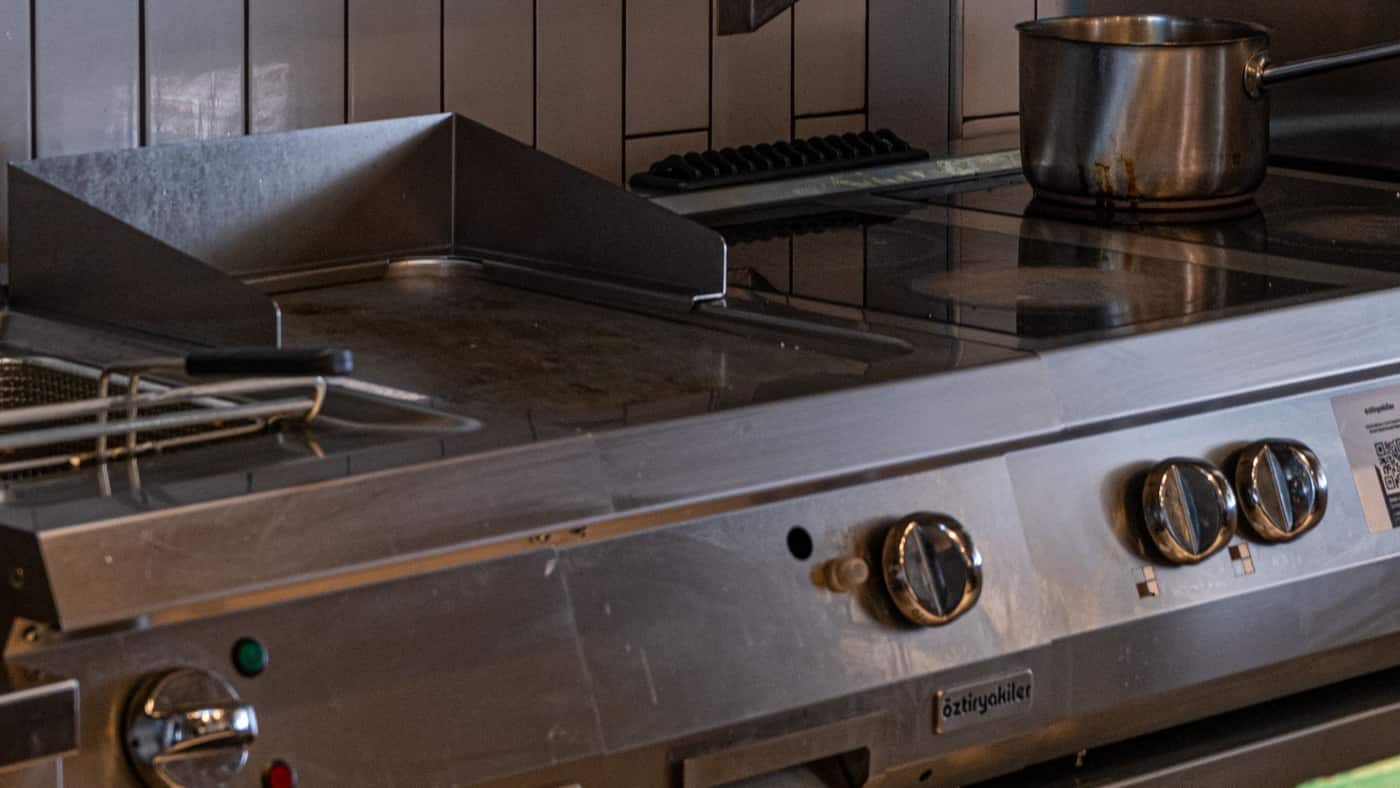
Fryer, oven and range maintenance in Minneapolis and St. Paul
Planned maintenance for fryers, ovens, ranges, griddles and charbroilers: boil-out, calibration, burners and pilots, flues, gas connectors and door seals.
What does a planned maintenance visit cover on fryers, ovens and ranges?
It covers the parts that drift or foul slowly: fryer vats, probes and flues, oven thermostat accuracy, burner flames, pilots and orifices, and the gas connector and restraint behind each appliance. Findings are reported, adjustments made during the visit, and anything that has failed is routed to repair.
What a cooking line equipment visit involves
Gas and electric cooking equipment fails in two ways. Some parts break suddenly, and those are repairs. Others get gradually worse until the food shows it: a thermostat that reads right and cooks wrong, a burner that burns yellow, a flue that clogs with oil. A planned visit goes after the second kind. It measures temperature against a reference, looks at flames and pilots, checks safety controls and examines the gas connection behind each appliance. For equipment that has already stopped working, start with commercial fryer repair, commercial oven repair or commercial range repair.
The hood above the line is a separate job. Kitchen exhaust hoods, fans and make-up air are handled under hood and ventilation service, and cleaning grease from hoods and ducts to NFPA 96 belongs to a specialist hood cleaning company, so neither is covered here. The same goes for fire suppression systems. What follows is the appliance side: what gets checked, what the manufacturers say about it, and where a maintenance visit stops.
What a cooking line equipment visit covers
- Gas fryers
The visit looks at temperature and high-limit probes, burners, pilot assemblies, gas valves and the flue. Frymaster's manual lists each of these as an item on its annual or periodic inspection.
- Electric fryers
Elements, contactors, probes and the high-limit take the place of burners. The boil-out procedure and probe checks are the same as on gas units.
- Convection and standard ovens
Thermostat accuracy, door seals, hinges and the fan path matter most. Calibration is slow, because the oven has to heat and cycle before readings mean anything.
- Ranges and hot tops
Open burners and oven burners each have an air shutter, pilot and orifice that can drift. The oven section and the top section are checked separately.
- Griddles
Burner flames under the plate, pilots and the thermostat bulb are checked, and the plate is looked at for level and warping. See griddle repair for failures.
- Charbroilers and salamanders
Radiants, burners and pilots clog with drippings, and flames behave differently once grease coats the burner. The visit adjusts air and clears blocked ports. Failures go to charbroiler repair.
What the visit finds and what we do about it
| Finding | Why it develops | What is done |
|---|---|---|
| Carbon film on fryer tubes and vat walls | Oil that has been heated repeatedly polymerizes into a hard brown varnish that insulates heat surfaces. Pitco's 35C Plus manual calls for a thorough cleaning once a week that includes draining and a boil-out. | Boil-outs differ by maker. Pitco's manual says to fill with water and noncaustic detergent, set the thermostat to 200°F, heat until the water just simmers (it must not be allowed to boil), and soak about 20 minutes. Frymaster's 24G manual says to simmer about 45 minutes. Follow the manual for the model. |
| Probes loose, fouled or no longer agreeing with the display | Heat cycling loosens fittings and oil film coats probes. Frymaster's inspection checklist asks that the temperature and high-limit probes be properly connected, tightened and functioning. | Probes are checked, tightened and compared with a reference thermometer. The high-limit is tested rather than assumed, and a probe that disagrees is replaced. |
| Oven thermostat averaging off the setting | Thermostats drift, and a single reading proves nothing because the oven cycles. Lang's FCOFL convection oven manual describes the check: a thermocouple at the center of the cavity, 350°F, at least half an hour of preheat, then readings at cycle-on and cycle-off over three cycles, averaged. | Adjustment is made in small steps and rechecked. A published calibration procedure for Vulcan-Hart convection ovens (a Parts Town knowledge-base article, not a maker document) treats an average within 25°F of the setting as acceptable before adjusting and calls for the thermostat to be replaced after three failed adjustments. Limits vary by maker, so the oven's own manual controls. |
| Burner flames yellow, lazy or lifting off the burner | Vulcan's service manual says burner performance depends on the balance of air and gas. A soft, lazy or yellow flame has too little primary air, and a flame lifting from the burner has too much. | The air shutter, about half open on natural gas and about 90% open on propane in Vulcan's manual, is adjusted until the flame stops lifting and then closed slightly. If that does not cure it, the burner is checked for obstructions. Flames are rechecked with grates and hot tops in place. |
| Pilot flame too weak or too large | Vulcan's V-series manual says an oven pilot should be large enough to engulf the thermocouple or sensor tip and turn it red hot, with a sharp two-tone blue flame on natural gas. A pilot that is too weak can drop out. | The pilot screw is adjusted by a technician: clockwise lowers the flame and counterclockwise raises it, and it must not be backed out too far or gas can leak. Lighting problems belong to the pilot light guide. |
| Burner nozzle or orifice partly blocked | Debris, carbon or damage at the nozzle starves a burner. Vulcan's manual says to remove the nozzle and check for blockage when burner operation stays poor after other systems have been checked. | The nozzle is cleaned or replaced. Every gas joint disturbed is leak-tested with a soap and water solution or a hazardous gas tester, never an open flame. |
| Flue opening restricted by oil or debris | Fryers cook oil into the flue area. Frymaster says to verify that the flue opening is not obstructed by debris or solidified oil or shortening, while Pitco recommends examining the flue area every six months with the cooker cooled, for corrosion or blockage. | The flue is cleared and the cabinet cleaned of oil build-up. Corroded flue parts are replaced, since a blocked or damaged flue upsets combustion. |
| Gas connector kinked, or its restraint cable disconnected | Caster-mounted equipment gets rolled out for cleaning. Dormont's installation guidance, built on ANSI Z21.69, calls for a restraining device so the connector is not strained, and the restraint cable has to be reattached whenever the appliance is pushed back after cleaning. | The connector, quick-disconnect and cable are inspected, the restraint reinstalled if it was left off, and connections leak-tested. Gas piping behind the wall belongs to a plumber or the utility. |
| Cleaner damage inside the oven | Lang's manual warns that caustic cleaning compounds should not touch the blower wheel and never to spray or hose the control console or electrical connections. | A corroded blower wheel or a console that has taken water is replaced. The manual's cleaning method is mild soap and a non-metal pad. |
Before the visit
- Let the equipment cool before the visit. A fryer vat should be drained of oil, and ovens, griddles and ranges should be cold so burners and thermostats can be reached.
- Do not hose or spray control consoles or electrical connections while cleaning beforehand. Lang's manual is explicit that water on the console does damage.
- Roll appliances out only as far as the connector and its restraint allow, and tell the technician if a cable has been left off.
- Write down what you have noticed: yellow flames, a pilot that drops out, slow recovery in the fryer, food that cooks off the dial. Include the date of the last boil-out.
- A gas smell at the cooking line during or after any of this work means everyone leaves the kitchen and the gas utility or 911 is called from outside. Do not light anything or flip switches.
Stop at gas valves, 208, 240 or 480 volt wiring, sealed refrigerant circuits, steam under pressure and anything live. Those are a call.
How long the equipment is out of use
Maintenance takes equipment out of service in a way repair does not, because the work is measuring. Lang's oven calibration alone calls for at least half an hour of preheat and three thermostat cycles, so each oven is out for that stretch, and fryers need oil drained and the vat cool. Take one line section at a time and keep the rest working. Plan visits for after close or between services, and remember that a closed line is also a good day for commercial refrigeration maintenance.
Between visits
- Boil out each fryer on its maker's schedule. Pitco's manual says weekly, and Frymaster's manuals vary by model, so follow yours and never drain boil-out solution into a built-in or portable filter system, as Frymaster's manual forbids.
- Clean ovens thoroughly once a week on top of daily wiping, with mild soap and a non-metal pad, and keep caustic cleaner off the blower wheel.
- With the burners off and the grates cool, lift the grates and clear boil-overs from the burners, then relight and look at the flame. It should not be yellow, lazy or lifting; any of those means the air shutter needs a technician.
- Keep each gas connector's restraint cable attached whenever the appliance is in service, and reattach it each time the appliance is pushed back after cleaning.
- Hang a thermometer in each oven and compare it with the dial a few times a year, writing the reading down so drift is visible.
When maintenance is not enough
Maintenance cannot fix a fryer vat that has cracked or leaks at a weld, burner tubes or heat exchangers that have rusted through, or an oven cavity that has corroded where the door seals. A thermostat that will not hold calibration after repeated adjustments is replaced, which the published Vulcan-Hart calibration procedure calls for after three failed attempts. When a part is cheap and the rest of the appliance is sound, repair makes sense, but a line of repeated failures in the same appliance points to its age.
Pieces of cooking line equipment by brand
Related to cooking line equipment
Repairs for this equipment
Related pages
Where it matters most
Where we service pieces of cooking line equipment
- Cooking line equipment service in Minneapolis, MN
- Cooking line equipment service in Minnetonka, MN
- Cooking line equipment service in New Brighton, MN
- Cooking line equipment service in New Hope, MN
- Cooking line equipment service in Oakdale, MN
- Cooking line equipment service in Plymouth, MN
- Cooking line equipment service in Prior Lake, MN
- Cooking line equipment service in Ramsey, MN
- Cooking line equipment service in Richfield, MN
- Cooking line equipment service in Rosemount, MN
- Cooking line equipment service in Roseville, MN
- Cooking line equipment service in Saint Paul, MN
Other maintenance and cleaning visits
Questions about pieces of cooking line equipment
Is a fryer boil-out the same on every brand?
No. Pitco's 35C Plus manual uses water with a noncaustic detergent, a 200°F setting, heating until the water just simmers (never boiling) and a soak of about 20 minutes. Frymaster's 24G manual calls for cleaning solution concentrate and a simmer of about 45 minutes. Temperatures and times differ by model, so use the manual that came with yours.
Where must boil-out water never be drained?
Frymaster's 24G manual says not to drain boil-out solution into a shortening disposal unit, a built-in filtration unit or a portable filter unit. Those are the shortening paths; boil-out solution is water and cleaner, so it has to leave the fryer by another route, and the manual's steps for your model say which.
What should a healthy range burner flame look like?
Vulcan's service manual describes the failures: a soft, lazy or yellow flame has too little primary air, and one lifting off the burner has too much. Both are corrected at the air shutter, which the manual puts about half open on natural gas, so a flame showing neither failure is the target.
How is oven thermostat accuracy checked?
Lang's FCOFL convection oven manual puts a thermometer or thermocouple in the center of the cavity, sets 350°F, preheats at least half an hour and records the temperature at cycle-on and cycle-off for three cycles. The six readings are averaged and compared with the setting. A single reading is not enough, because the oven swings.
Why does a gas range on casters need a restraint cable?
Watts, the maker of Dormont connectors, says ANSI Z21.69 calls for a restraining device on each gas connector used with caster-mounted or fixed-leg equipment that is moved for cleaning or service. Without one, a rolled appliance can pull on the connector and strain its fittings.
How often should a fryer flue be inspected?
Pitco's manual recommends examining the flue area every six months with the cooker cooled, looking for corrosion or blockage. Frymaster's manual includes the flue opening in its annual or periodic inspection by qualified service personnel. A fryer cooking in a greasy kitchen should lean to the shorter interval.
Sources
- Pitco 35C Plus manual: weekly cleaning, boil-out, flue inspection
- Frymaster 24G series manual: boil-out procedure
- Frymaster 24G series manual: annual and periodic system inspection
- Vulcan V Series HDR gas ranges service manual: air shutter, pilot, orifice
- Lang convection oven manual: calibration check and adjustment
- Lang convection oven manual: maintenance and cleaning
- Parts Town knowledge base: Vulcan-Hart convection oven thermostat calibration (not a Vulcan-Hart document)
- Watts (Dormont): restraining device kit for gas connectors, ANSI Z21.69