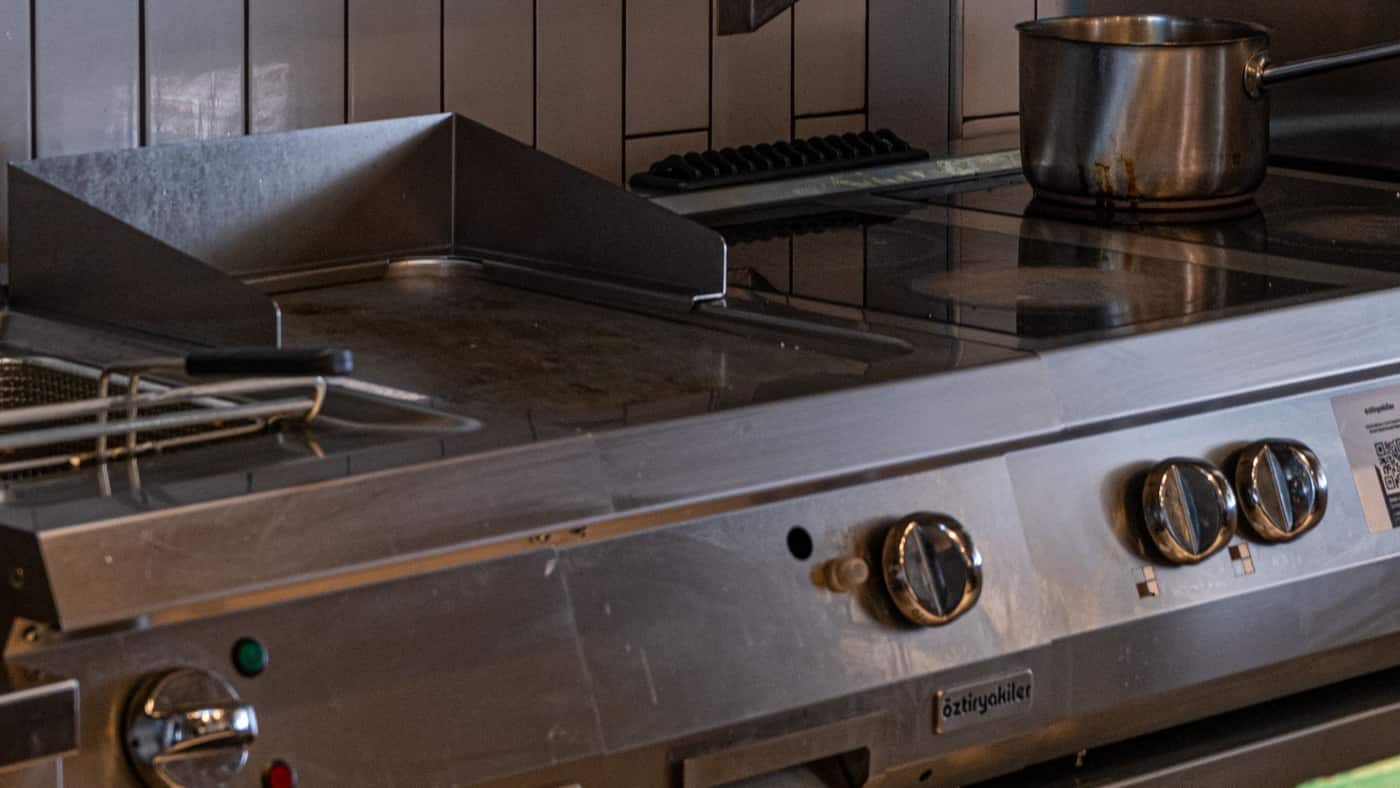
Commercial range repair in Minneapolis and St. Paul
On-site repair for commercial gas and electric ranges: burners, pilots, valves, oven thermostats, safety valves, hinges and elements.
Why won't the oven or burners on my commercial range light?
On a gas range, no light usually means a dead pilot, a clogged burner port, a failed thermocouple or safety valve, or a gas supply that has been shut. Electric ranges fail on a burned element, contactor or thermostat. Never relight a pilot you can smell gas around; leave and call the gas utility.
About commercial range repair
A commercial range is a stack of several cooking jobs in one cabinet: open burners or hot tops on top, an oven underneath, sometimes a griddle section or a salamander above. Each of them can fail on its own, and a failure on one section often gets mistaken for a failure of the whole range. The burner that will not light and the oven that will not hold 350 are different repairs with different parts. Our commercial oven repair page covers standalone ovens and this page covers the range as a unit.
Most ranges in Twin Cities kitchens run on natural gas, with electric ranges common in schools, care facilities and older buildings that were never piped for gas. We repair both on site, at the business. Anything that touches gas valves or 208 or 240 volt wiring is technician work. If you smell gas, leave the building and call the gas utility or 911 from outside before you do anything else.
Kinds of commercial ranges we repair
- Open-burner gas range with standing pilots
Each burner has its own pilot flame that burns all day. Pilots foul with grease and spilled liquid, and a pilot that has blown out is the single most common reason a burner will not light.
- Electronic-ignition gas range
Replaces standing pilots with a spark or hot-surface igniter. Failures shift to igniters, ignition modules and flame sensors, and a power loss stops all lighting at once.
- Hot-top or French-top range
A solid plate heated by a burner ring beneath it. Warped plates and a burner that has drifted off center produce cold zones that look like thermostat faults.
- Electric range with coil or flat-plate elements
Elements, infinite switches and contactors do the work. Failures are usually electrical: a burned-through element, a stuck contactor or a switch that has lost a position.
- Range with convection or standard oven base
The oven has its own thermostat, safety valve and door. Convection bases add a fan motor and a second airflow path to diagnose.
- Heavy-duty restaurant range with a salamander or griddle section
Combination units share one gas supply but separate controls. See our griddle repair page for flat-top sections.
Complaint, cause, correction
| Complaint | Likely cause | Correction |
|---|---|---|
| One open burner will not light while the others do | A clogged burner port or a dirty pilot orifice. Grease and boil-over carbon plug the small ports on the burner head, so gas arrives but spreads unevenly or not at all. | Remove and clean the burner head and pilot, check for the pilot flame reaching the burner, and replace a burner or pilot that is cracked or burned. |
| Pilot goes out when the oven door is shut or the burner is turned down | A weak thermocouple or thermopile that no longer generates enough millivolts, a pilot flame set too low, or a drafty hood pulling the flame off its sensor. | Test the thermocouple output, clean and adjust the pilot flame to the manual, and replace the thermocouple or safety valve if it will not hold. |
| Oven will not light but the burners work | The oven has a separate safety valve and thermostat. A failed oven safety valve, a weak thermocouple or an oven thermostat stuck in the off position will leave the main burner cold. | A technician checks pilot and thermocouple, tests the safety valve and thermostat, and replaces the valve if it fails to open. Gas valve work is not an operator task. |
| Oven temperature far from the dial setting | A thermostat out of calibration, a failed capillary bulb, or the bulb sitting in the wrong place after a rack or panel was removed and replaced. | Test the oven with a calibrated probe, recalibrate or replace the thermostat and reseat the bulb in its clip. |
| Oven door will not seal or hangs open | Worn or bent door hinges, broken springs or a damaged gasket. Heat leaks around the door, the oven overruns its cycle and the burner stays on trying to recover. | Replace hinges and springs, adjust the door alignment and swap the gasket. A door that sags also loosens oven alignment over time. |
| Burner flame is yellow, lazy or lifts off the head | Incorrect air-to-gas mixture from a dirty air shutter, a partly blocked orifice or a regulator out of range. Yellow flame throws soot and wastes heat. | Clean the air shutter and orifice, set the shutter for a blue flame with a distinct inner cone and check manifold pressure against the rating plate. |
| Electric element does not heat or heats only in part | A burned-out coil, a bad receptacle, a failed infinite switch or a contactor with pitted contacts. Heavy loads cook the terminal connections over time. | Meter the element and switch, replace the failed part and check terminals for discoloration. Do not tighten live connections yourself. |
| Clicking with no flame on an electronic-ignition range | A fouled igniter, a missing ground, a failed ignition module or a dirty flame sensor. The spark fires but the flame is not proven. | Clean and check the igniter gap, test the ground and module and replace the sensor or module that fails. |
| Gas smell near the range | A leaking fitting, a pilot that blew out while gas still flowed or a valve that is not seating. This is a safety issue, not a repair to troubleshoot. | Leave, call the gas utility or 911 from outside and do not operate switches. Equipment repairs come after the utility declares the area safe. |
Check these before you call
- Make sure the gas shutoff to the range is open and that the range has not been bumped or moved out of its connector.
- Look for a tripped breaker on electric ranges, and for a tripped breaker or blown fuse that powers electronic ignition on gas models.
- Check that burner heads and caps are seated correctly. A cap sitting crooked will keep a burner from lighting evenly.
- Check that the oven thermostat knob has not been turned past its stop or knocked to a different setting during cleaning.
- Clean around pilot areas with the equipment cold, and confirm no foil or liners block the oven vents.
- A gas odor near the range burners or oven pilot means leave first and phone the utility or 911 from outdoors. Do not relight pilots.
Stop at gas valves, 208, 240 or 480 volt wiring, sealed refrigerant circuits, steam under pressure and anything live. Those are a call.
While it is down
A dead range often takes out several stations at once. Move the heaviest items to what still works: a working burner section can handle sauté while an oven-only fault sends braises to a combi oven or a convection oven. Keep a list of which burners and which oven are affected, because it helps the technician narrow the cause. If you smell gas, close the shutoff only if it is safe to do so, leave and call the gas utility from outside. Do not light matches or lighters near the range. Tell us the make, model and serial number from the data plate when you call.
Upkeep that prevents the calls
- Pull and clean burner heads, pilots and the area underneath the grates on a set schedule, weekly in a high-volume kitchen.
- Wipe up boil-overs promptly. Sugars and starches carbonize and plug the burner ports and pilot orifice.
- Check oven doors, hinges and gaskets monthly for a tight seal and for sagging.
- Verify oven temperature with a standalone thermometer at a regular interval so thermostat drift is caught before food suffers.
- Keep the flue and the back of the range clear of grease and cardboard so combustion air is not blocked.
- Have a technician check manifold pressure, pilot output and safety valves as part of a preventive maintenance visit.
Repair or replace
A well-built commercial range often outlasts the menu it was bought for, and most burner, pilot, valve and thermostat repairs are worth doing. Replacement becomes the better call when the frame or oven cavity is rusted through, when several burners and the oven have failed in the same year, or when parts for an older model are no longer available. A range that needs repeated pilot, valve and door work is also telling you its safety components are tired. Our repair or replace guide lays out the thresholds, and a written estimate lets you compare repair against a new range.
Brands we repair
See also
Related repairs
Where it matters most
Where we repair commercial ranges
- Commercial range repair in Forest Lake, MN
- Commercial range repair in Fridley, MN
- Commercial range repair in Golden Valley, MN
- Commercial range repair in Hastings, MN
- Commercial range repair in Inver Grove Heights, MN
- Commercial range repair in Lakeville, MN
- Commercial range repair in Lino Lakes, MN
- Commercial range repair in Maple Grove, MN
- Commercial range repair in Maplewood, MN
- Commercial range repair in Minneapolis, MN
- Commercial range repair in Minnetonka, MN
- Commercial range repair in New Brighton, MN
More cooking equipment repair
Commercial range repair questions
Why does my range oven light on the second try but not the first?
A weak thermocouple or a dirty pilot gives the safety valve just enough signal on a warm start and not on a cold one. It tends to get worse over a few weeks. A technician tests millivolt output and the safety valve, then replaces whichever is failing.
Is a yellow burner flame a problem?
Yes. A yellow, sooty flame means poor mixing of air and gas, usually from a dirty air shutter or blocked orifice, and it can deposit carbon on pans and in the burner. A properly adjusted burner has a steady blue flame with a clear inner cone.
Can I convert my range between natural gas and propane myself?
No. Conversion changes orifices, regulators and sometimes safety valves, and it has to match the rating plate. Gas conversion and pressure checks are technician work, and the gas supply side of the meter is the utility's responsibility.
What is the difference between a thermocouple and a thermopile on a range?
A thermocouple produces a small voltage that holds a safety valve open while the pilot burns. A thermopile is several thermocouples in series and produces enough voltage to run a millivolt control. Both fail by weakening, so a reading under spec means replacement.
Why does my oven overheat after the door sits open for a while?
The thermostat sensed a cold cavity and held the burner on at full while the door was open. If the temperature then overshoots after the door closes, the thermostat may be slow or out of calibration. A calibrated test probe confirms the drift.
Do electric ranges need regular service too?
Yes. Elements and receptacles wear from heat cycling, and loose terminals cook themselves over time. A technician checks element resistance, contactor contacts and terminal condition, then replaces anything that shows burn marks or a reading out of range.