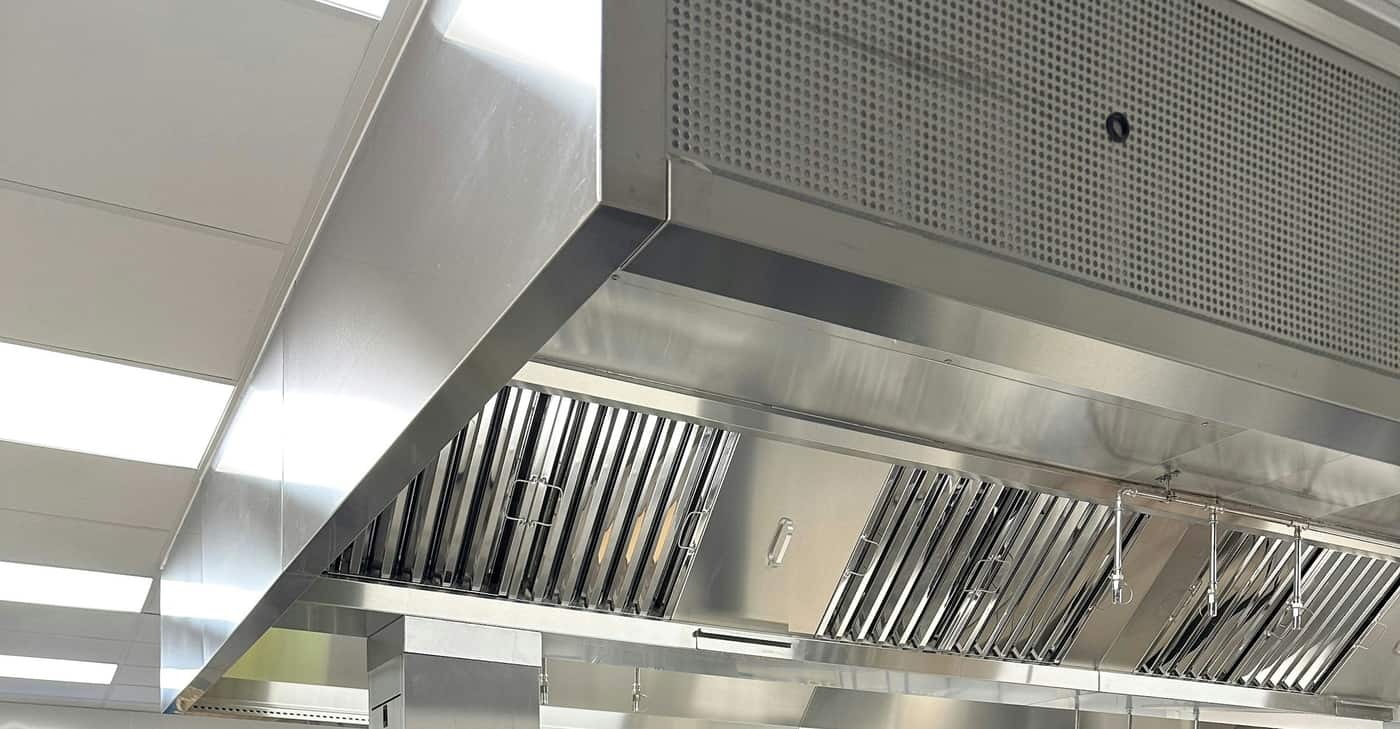
Commercial kitchen hood, exhaust fan and make-up air repair in Minneapolis and St. Paul
Commercial kitchen hood repair, restaurant exhaust fan repair and make-up air unit repair in Minneapolis and St. Paul, on site with a written price first.
Why is my kitchen hood not pulling smoke?
The usual causes are an exhaust fan that has slowed or stopped, a slipping belt, loaded filters, or too little make-up air entering the room. A fan that turns backward after electrical work does it too. We find which one with airflow and amp readings, then repair the fan, belt, motor, filters or make-up air unit.
About kitchen exhaust hood and ventilation system repair
The hood over your line only works as part of a loop. The exhaust fan pulls air and grease vapor out through the hood, and the make-up air unit puts back what was removed. When either half drifts, the kitchen tells you: smoke rolls out past the hood edge, the line runs hot, the back door is hard to pull open. We service both halves, plus the filters, lights and controls in between.
This page is for the mechanical side of the hood. Pair it with commercial range repair and commercial fryer repair when the appliance under the hood is part of the problem, because a weak hood and a weak burner can look alike from the cook's side of the line. We work on site, give you a diagnosis and a written price before any repair starts, and say plainly when a job belongs to a different contractor.
Kinds of kitchen exhaust hoods and ventilation systems we repair
- Type I hood (grease)
Sits over fryers, ranges, griddles and charbroilers, where cooking throws off grease-laden vapor. It carries baffle or cartridge filters and a grease cup, and its fan and controls are what we repair. Grease cleaning of the hood and duct is a separate trade.
- Type II hood (heat and steam)
Sits over dish machines and some ovens, where the load is steam, heat and odor instead of grease. These have no grease filters, so failures are fans, dampers, lights and the air balance around them.
- Upblast roof exhaust fan
A belt-driven or direct-drive fan on a curb on the roof, discharging upward. Belts, bearings, motors, the hinge kit and the grease drain are the wear points, and the roof access is part of every job.
- Utility-set and in-line exhaust fan
A fan inside a mechanical room or on the ground, ducted to the hood and to the outdoors. Belt guards, motor mounts, shaft bearings and vibration are the usual repair items.
- Direct-fired make-up air unit
A rooftop gas unit that heats 100 percent outdoor air with a burner in the air stream. Burner, flame safeguard, gas valve, discharge sensor and dampers decide whether it runs in a Minnesota January.
- Tempered make-up air and hood-integrated supply
Units or hood plenums that bring in lightly heated or unheated outdoor air near the hood. Coils, freeze protection, dampers, filters and control wiring are the repair items.
Complaint, cause, correction
| Complaint | Likely cause | Correction |
|---|---|---|
| Smoke or steam rolls out past the front of the hood | The exhaust is moving less air than the hood was designed for. A slipping or broken belt, a worn fan wheel, plugged filters or a fan running backward after wiring work all reduce capture. | We measure fan speed and motor amps, inspect the belt and sheave, check rotation, and look at the filters. The weak link is repaired and the capture is checked again with the line running. |
| The kitchen is hot even with the hood on | Heat that should leave through the hood stays in the room. That points to lower exhaust airflow, a closed or stuck damper, or make-up air that has shut off and left the room starved. | We check that the fan and the make-up air unit both start together, then read airflow at the hood and at the supply. A tripped limit, dead motor or failed damper actuator is repaired or replaced. |
| Doors are hard to open and pull inward | The room is under negative pressure. The hood removes more air than the make-up air unit returns, so the building pulls air through doors, gaps and the flues of gas appliances. | We confirm the make-up air unit is running and delivering, clear loaded supply filters, and check dampers and fan speed. If the room needs a rebalance, we tell you what the building and the hood supplier must decide. |
| Pilot lights blow out or flames lean toward the hood | Negative pressure and strong hood draft pull flames off their sensors, and a make-up air blast aimed at the line can also push a pilot out. The cook sees it as an appliance fault. | We look at the air path before the appliance: make-up air position, discharge direction and fan speed. If the appliance is also weak, it gets its own diagnosis. |
| Exhaust fan is loud, shaking or squealing | A dry or failing bearing, a worn belt, a loose wheel on the shaft or an out-of-balance wheel coated in grease. Vibration shakes the curb and the duct and shortens the life of everything attached. | We shut it down, check the wheel and shaft, replace bearings and belts, and balance or replace the wheel when needed. A fan that squeals today often seizes next month. |
| Make-up air unit will not light, or trips out in cold weather | Direct-fired units run a flame safeguard through a sequence: airflow proven, spark, pilot, main valve. A dirty flame sensor, a weak gas valve, an iced or stuck damper, a tripped freeze stat or a sensor reading the wrong air temperature can each lock it out. | A technician steps the unit through its start sequence, reads the lockout code on most models, and tests the sensor and valve. Gas valve and burner work is technician-only, and it is not a reset-and-hope job. |
| Hood lights are out or the light switch does nothing | A failed lamp, a cracked or loose vapor-proof globe, a burned socket, a failed driver on LED fixtures or a bad switch or fuse. Moisture and grease get into fixtures over the years. | We replace the lamp or driver, reseal the globe and test the circuit. If a fixture runs hot or arcs, it is replaced rather than patched. |
| Exhaust fan runs all day at full speed, or never speeds up | On hoods with demand-control ventilation, temperature or optical sensors tell a variable frequency drive how fast to run the fan. A fouled sensor, a faulted drive or a bad control wire leaves it stuck at one speed. | We clean and test the sensors, read the drive's fault history, check the parameters against the nameplate and confirm the fan modulates with the line on and off. |
| Grease dripping from the roof fan or running down the curb | A full or missing grease cup, a blocked drain on the fan housing or a fan that has not been serviced and has grease pooling in its scroll. It stains the roof and can reach the electrical disconnect. | We clear the drain, replace the cup or its container and check the hinge kit. Cleaning the duct and hood interior to NFPA 96 belongs to a hood cleaning company, and we tell you if the buildup is beyond our scope. |
Check these before you call
- Look at the hood switch and the make-up air switch. On many lines they are separate, and a night crew will sometimes turn one off without the other.
- Check that the hood filters are in place, seated and not loaded with grease. A filter left out or an open slot changes how air moves under the hood.
- Notice whether the room has gone negative: a door that pulls shut or a draft whistling under it means the make-up air is not keeping up.
- Look at the control panel or breaker for a tripped switch on the fan or the make-up air unit. Reset a breaker once at most; a second trip is a fault.
- Write down what the hood does with the fryers and charbroiler on versus off, and any error code on the make-up air unit, then call us.
Stop at gas valves, 208, 240 or 480 volt wiring, sealed refrigerant circuits, steam under pressure and anything live. Those are a call.
While it is down
A hood that will not pull smoke is a safety and health problem, and many jurisdictions expect the cooking under it to stop. Shut off the appliances that make grease vapor, usually fryers, griddles and charbroilers, until airflow is restored. Keep serving from equipment that does not need the hood, such as cold prep and some ovens, where your local rules allow. If smoke is already filling the room, turn the appliances off and open the doors. Tell the technician what the hood did, when it changed, and whether any suppression nozzle or fusible link was touched.
Upkeep that prevents the calls
- Have the fan belt tension and condition checked on a schedule, and keep a spare belt of the right size, since a snapped belt stops the hood at once.
- Grease the fan bearings where the fan has grease fittings, and listen for change in the sound of the fan from the roof or mechanical room.
- Wash or replace hood filters on a set cycle, and keep an eye on the grease cup, because it fills faster than you expect.
- Change make-up air unit filters and clear leaves, snow and ice from its intake before and during the heating season.
- Test hood lights and controls at each visit and photograph the fan and make-up air nameplates so parts can be matched from the first call.
Repair or replace
Exhaust fans and make-up air units run for years, and most repairs are small: a belt, a bearing, a motor, a sensor, a gas valve. Repair stops making sense when the fan housing is rusted through, a burner section is cracked or a heat exchanger has failed, because those parts cost more than the repair is worth. A hood redesign or a new fan sized for new equipment is a job for the hood supplier or a mechanical contractor. We tell you which side of the line your repair sits on. The repair or replace guide is a useful read before you decide.
See also
Related repairs
Where it matters most
Where we repair kitchen exhaust hoods and ventilation systems
- Kitchen exhaust hood and ventilation system repair in Woodbury, MN
- Kitchen exhaust hood and ventilation system repair in Andover, MN
- Kitchen exhaust hood and ventilation system repair in Apple Valley, MN
- Kitchen exhaust hood and ventilation system repair in Blaine, MN
- Kitchen exhaust hood and ventilation system repair in Bloomington, MN
- Kitchen exhaust hood and ventilation system repair in Brooklyn Center, MN
- Kitchen exhaust hood and ventilation system repair in Brooklyn Park, MN
- Kitchen exhaust hood and ventilation system repair in Burnsville, MN
- Kitchen exhaust hood and ventilation system repair in Champlin, MN
- Kitchen exhaust hood and ventilation system repair in Chanhassen, MN
- Kitchen exhaust hood and ventilation system repair in Chaska, MN
- Kitchen exhaust hood and ventilation system repair in Columbia Heights, MN
Kitchen exhaust hood and ventilation system repair questions
How is a hood tied to the fire suppression system and the gas valve?
On most installations the appliances under the hood are connected to the fire suppression system. When the system is released, it closes the gas valve and cuts power to the appliances, and many designs also keep or shut the exhaust. Your local code and the system design decide the details. We do not service the suppression system itself.
What is the difference between a Type I and a Type II hood?
A Type I hood handles grease-laden vapor over fryers, ranges, griddles and charbroilers, so it has grease filters and a grease path. A Type II hood handles heat, steam and odor over dish machines and some ovens and has no grease filters. Your mechanical code decides which appliances need which.
Why does my make-up air unit shut down when it gets very cold?
Direct-fired units lock out on safety controls: a freeze stat, a failed flame sensor, a limit or a frozen damper. Cold also loads intake filters with snow. A lockout is the unit protecting itself, so a technician should read the code and find the cause before it is reset again.
Can a bad exhaust fan make my pilots go out?
Yes, indirectly. A weak or unbalanced hood leaves the room under negative pressure, and that draws flame off the pilot or pulls combustion gases in. A strong draft can also blow a pilot out directly. We check the air path first and the appliance second, so one fault is not mistaken for the other.
What does a variable frequency drive do on a kitchen exhaust fan?
A drive changes the speed of the fan motor. With demand-control ventilation, temperature and optic sensors under the hood tell the drive to speed up while you cook and slow down when you do not. A fouled sensor or a drive fault leaves the fan stuck at one speed.
Who cleans the grease out of the hood and duct?
A hood cleaning company does, working to NFPA 96. We repair the fan, belts, bearings, motor, filters, lights, controls and make-up air, and we will point out heavy buildup we see. We do not clean grease from hoods and ducts and we do not service fire suppression systems.