Hobart dishmachine, mixer and slicer repair in the Twin Cities
On-site Hobart dishmachine, mixer and slicer repair in Minneapolis and St. Paul. You get a diagnosis and a written price to approve before work starts.
What fails most often on Hobart dishmachines, mixers and slicers?
Hobart dishmachines usually fail at the wash pump seal, the final-rinse solenoid, the booster heater and the tank elements. Mixers wear the bowl-guard interlock, the timer and the transmission seals. Slicers need knife, sharpener and gauge-plate work. Most of it is routine wear on machines built to be serviced, and hard water makes the dishmachine side worse.
About Hobart equipment
Hobart is the Troy, Ohio, company that has built commercial dishmachines, planetary mixers and slicers for well over a century. It is part of the Illinois Tool Works food equipment group, alongside Vulcan and Traulsen. If you walk into a school kitchen, a hospital dish room, a hotel banquet kitchen or a grocery deli, there is a good chance the machine at the end of the dish line, the mixer on the bakery floor or the slicer behind the deli counter says Hobart.
What makes Hobart different to repair is how long the machines last and how much of a problem sits outside the machine. A Hobart mixer can run for decades and still need nothing but seals and a timer. A commercial dishwasher failing its rinse is often a booster, a scaled valve or cold winter inlet water rather than a bad machine. We also repair Hobart commercial mixers and meat slicers for the same reason: they are worth fixing.
Hobart dishmachines: door-type, conveyor and undercounter
Equipment guide
Seen on this line: Final rinse below spec from a failed or scaled booster heater / Leaking wash pump seal / Scaled tank elements or a sticking rinse solenoid / Conveyor drive, curtain or door problems
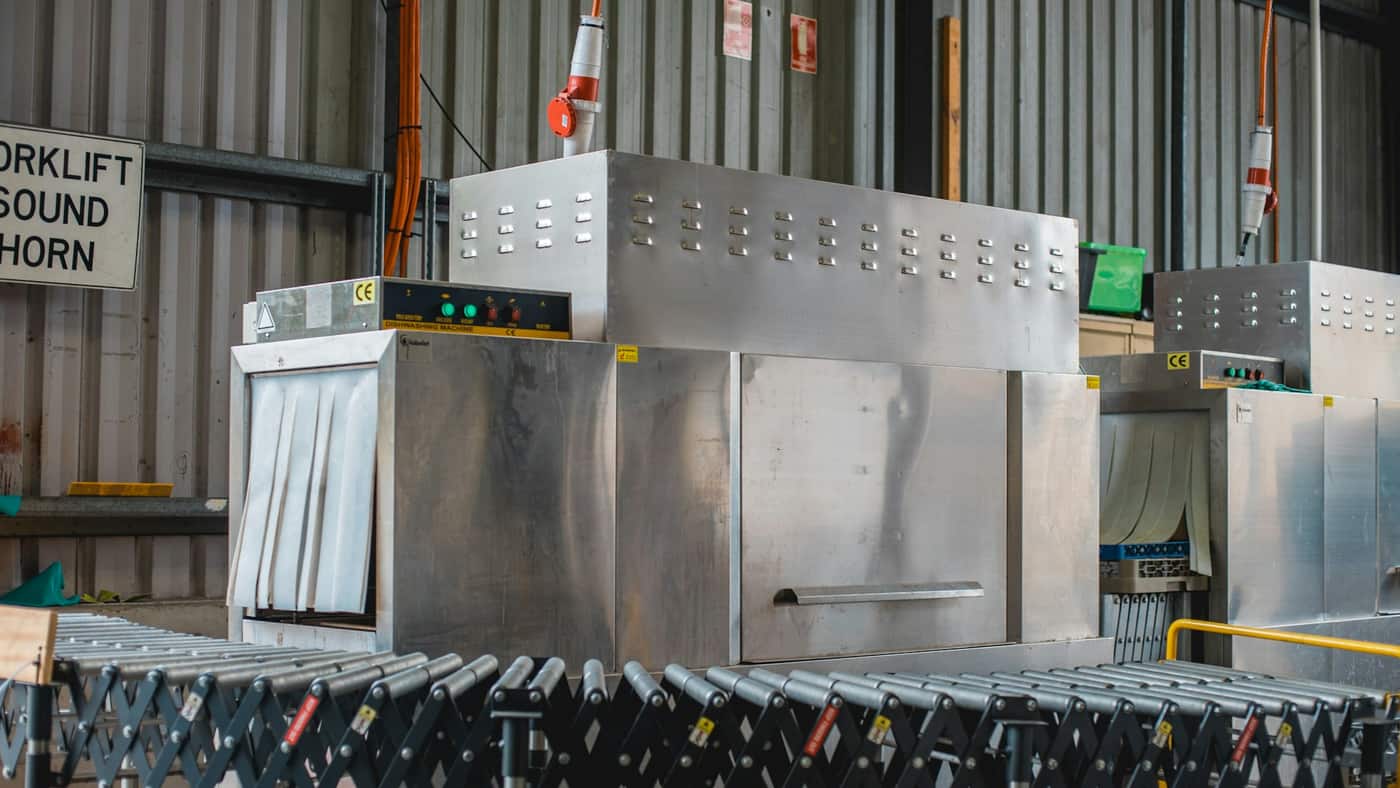
A Hobart high-temperature machine is built around a wash tank with its own heating elements, a pump that drives the wash arms, and a final rinse fed through a booster heater. Most calls come from that chain. A worn pump seal drips at the pump housing and eventually fails the bearings. A weak or scaled booster leaves the final rinse below the roughly 180°F a high-temperature machine is specified for, and the thermometer label shows it. Rinse solenoids stick on scale and the vacuum breaker leaks when the rinse valve does. On conveyor machines, such as the CL series, and flight-type units like the FT900, we also see worn conveyor drive parts, door and curtain damage, and tank fill probe problems. Hard water in the Twin Cities coats elements and clogs rinse nozzles.
Hobart planetary mixers: A200 to HL1400
Equipment guide
Seen on this line: Transmission seal leaking lubricant / Timer sticking or not counting down / Bowl-guard interlock fails, no start / Speed-shift lever stiff or slipping
Hobart planetary mixers range from the 20-quart A200 and HL200 up through the 60- and 80-quart HL600 and HL800 to the floor-standing 140-quart HL1400. All of them run a gear transmission with a speed-shift selector, a bowl guard that stops the mixer when it is open, a bowl-lift mechanism and a hub for attachments. The common repairs follow from that. Transmission seals leak lubricant. The mechanical or electronic timer sticks or stops counting. The bowl-guard interlock fails, so the mixer will not start. Shift levers get stiff or jump out of gear, and the bowl lift wears and no longer holds the bowl at height. Mixers that stop mid-batch and restart after a rest are often tripping the motor's thermal protector under a heavy dough load.
Hobart slicers: HS and EDGE series, plus older 2612 and 2912 models
Equipment guide
Seen on this line: Ragged or inconsistent cut from a dull knife / Sharpener stones worn or out of alignment / Gauge plate not returning to zero / Drive belt slipping or knife motor not starting
Hobart slicers from the current HS and EDGE models to the older 2612, 2812 and 2912 are belt- or gear-driven, with a knife, a built-in sharpener and a gauge plate that sets the slice thickness. The failures are mechanical and predictable. A knife that is dull or has lost its edge from poor sharpening gives ragged cuts. Worn sharpener stones or misaligned sharpeners stop doing their job. A gauge plate that no longer zeroes means slices are thicker than the dial says. Drive belts slip and wear, and motor start components fail. Ring guards and knife covers have safety interlocks that must work. We do the sharpening and adjustment ourselves; never reach near the knife edge, and do not remove guards to speed up cleaning.
Finding the model and serial plate
On Hobart equipment the data plate carries the model, serial number, electrical rating and, on dishmachines, the required wash and rinse temperatures and water supply. On dishmachines it is on the front or side of the machine or the control panel. On mixers it is on the body or column, and on slicers it is on the base. On many newer Hobart units the serial number can be used to place the build date. Photograph the plate and note the exact symptom before you call.
Parts
Hobart sells parts through its own service network, and many wear parts such as pump seals, rinse solenoids, heating elements, mixer timers and slicer sharpener stones come in OEM and compatible aftermarket versions. Control boards, wash pump assemblies and transmission components are better bought as OEM so the fit and rating are right. Older legacy models can mean a longer search or a reconditioned part. Hobart parts are matched to the full model and serial before anything is ordered.
Manufacturer warranty
If this equipment is still under the manufacturer's warranty, it should usually go through the manufacturer's authorized service network first. We are an independent company and not the manufacturer.
See also
Hobart repair questions
Why does my Hobart dishmachine wash fine but dishes fail the sanitizing check?
On a high-temperature machine the final rinse has to reach roughly 180°F at the manifold. If it does not, the booster heater is weak or scaled, the rinse solenoid is sticking, or the incoming hot water is too cool. On a chemical-sanitizing machine the sanitizer feed or concentration is the first suspect. Test strips and a thermometer tell you which.
Is the problem my Hobart dishmachine or the building's hot water?
It can be either, and it is often both. We check incoming water temperature, line pressure and the booster before we blame the machine. In Minnesota winters the incoming water is cold and a booster that was just adequate in summer falls behind. Hard water also scales elements and rinse nozzles, which looks like a machine fault.
My Hobart mixer stops partway through a heavy dough and starts again after a few minutes. Why?
That is usually the motor's thermal overload cutting out. A stiff dough, too large a batch, a dry transmission or a worn motor makes it run hot. If it keeps happening on normal loads, the motor, capacitor or transmission needs checking. Running it again and again against the overload shortens the motor's life.
Why is my Hobart slicer leaving a ragged cut even after I sharpened it?
A knife can be sharp and still cut poorly if the edge has a burr, the sharpener stones are worn or glazed, or the knife is not seated square. The gauge plate may also be out of true. A technician can check the knife, stones and alignment. Do not touch the edge to test it.
Is it worth rebuilding an old Hobart mixer or should I replace it?
Often a rebuild is worth it. The castings, gear train and bowl-lift on a Hobart mixer can outlast the seals and timer by years. Replacement makes sense when the transmission is damaged or the motor and gears are both failing. Our maintenance checklist notes the lubrication and checks that extend that life.