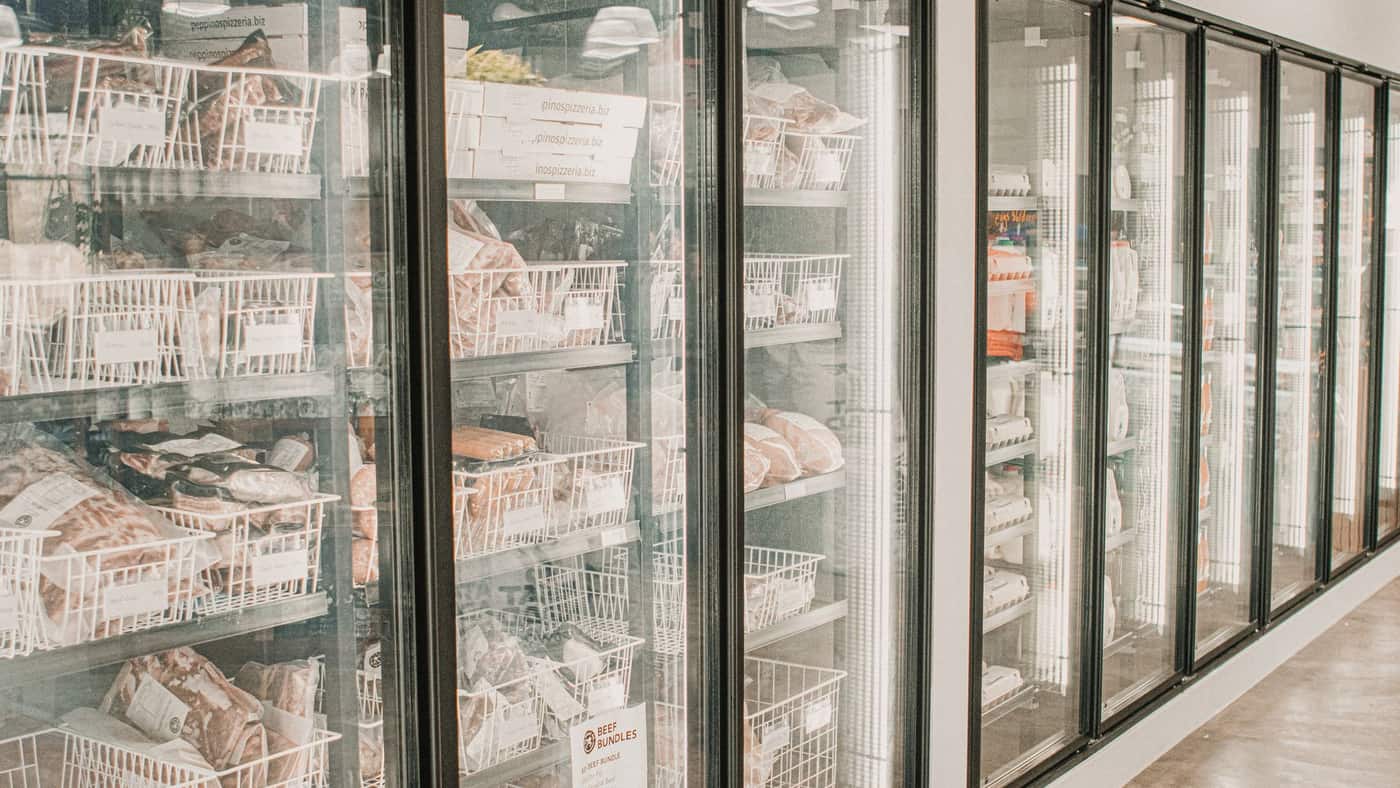
Display case and merchandiser repair in Minneapolis and St. Paul
Deli, bakery and grab-and-go display case repair on site in the Twin Cities: warm cases, frosted coils, fan and defrost faults, gaskets and controls.
Why is my display case not keeping product cold?
A display case that runs warm usually has a dirty or blocked condenser, a failed evaporator fan, a frosted coil from a defrost fault, or a worn door gasket. A thermostat or controller fault is the next suspect. Clear the condenser, check the gaskets, and call if the case still reads above 41°F.
About display case repair
A display case is the one piece of refrigeration your customers see. A deli case, a bakery case or a glass-door grab-and-go merchandiser has to hold product at a safe temperature and look clean while it does it. When the case drifts warm, you lose the product and you lose the sale of whatever is sitting behind the glass. Health inspectors also read the thermometer in the case, so a warm display is a compliance problem as well as a sales one.
Display cases fail differently than a back-of-house cooler. They sit under hot lights, near doors, in rooms where staff and customers constantly disturb the air. Staff reach in all day, and spills, flour and cleaning chemicals end up in the base. Many are fed by a remote rack or a condensing unit, so a warm case can be a case problem or a system problem. We sort that out first, then give you a written price. For the wider picture see our commercial refrigeration repair page, or reach-in cooler repair for back-of-house units.
Kinds of display cases we repair
- Self-contained deli and meat case
The compressor and condenser sit in the base of the case. Most warm-case calls on these come back to a condenser clogged with flour, lint or grease, or to a fan that has stopped.
- Remote-condensing or rack-fed case
Refrigerant comes from a compressor somewhere else in the building or on the roof. The case itself holds the coil, fans, defrost and an expansion or solenoid valve, so the diagnosis starts with which side is at fault.
- Glass-door grab-and-go merchandiser
A vertical case with swing or sliding doors, often with a top sign and interior LED strips. Door closing, gasket seal and door heaters decide how well it holds temperature and how much it fogs.
- Open-front multi-deck case
No doors, so the case relies on an air curtain. A blocked return grille or a weak fan breaks the curtain and the shelves warm up, especially near an entrance or a supply vent.
- Refrigerated bakery and pastry case
Cooler than a dry case and often with glass on four sides. Fogging, condensation and sweating on the glass are as common as temperature faults.
- Curved-glass service case
Large front glass is expensive and sometimes has to be ordered to size. We note glass condition on the estimate so you can decide before the repair rather than after.
Complaint, cause, correction
| Complaint | Likely cause | Correction |
|---|---|---|
| Case reads warm all day, compressor running constantly | A condenser coil packed with dust, flour or grease cannot reject heat, so the compressor runs without making cold. A failed condenser fan gives the same result. | We clean the coil and test the fan motor and capacitor. If head pressure stays abnormal after cleaning we look at the charge, and sealed-system work may only be done by someone holding EPA Section 608 certification. |
| Case is warm and the compressor is not running | A tripped breaker, a failed start relay or capacitor, a tripped overload, or a controller that has stopped calling for cooling. A dead thermostat or probe can leave a case off with the display lit. | We check supply voltage first, then test the start components and the control. Replacing a relay or capacitor is usually straightforward once the cause is confirmed. |
| Frost or ice on the back coil behind the product | A defrost heater, termination thermostat, timer or controller output has failed, so frost builds until air can no longer pass through the coil. It can also follow a door left ajar or a drain freezing. | We test the heater element and termination switch, confirm the control actually energizes the heater, and clear the drain. A manual defrost without fixing the cause only buys a few days. |
| Water on the floor or pooling under the case | A plugged defrost drain, a cracked drain pan, a loose drain line, or an evaporation pan that no longer heats. Condensation from a failed gasket can drip as well. | We flush the drain, check the slope and the trap, and test the pan heater. If the line is shared with other equipment we check where else the water is backing up. |
| Evaporator fan silent or noisy | A seized or worn fan motor, a bent blade, or a blade rubbing on frost. Without airflow the coil freezes solid and the shelves warm up even though the compressor runs. | We replace the motor with a matching one and recheck defrost, since ice that rubbed the blade usually points to an upstream defrost fault. |
| Glass fogging or sweating on the front | A weak door gasket, an open door, a failed glass or frame heater, or a case set colder than the room humidity can support. Open cases fog when the air curtain is broken. | We replace the gasket, test the heater circuit and check the thermostat setting. Fogging that returns every afternoon often tracks the room's humidity, not the case. |
| Lights out or flickering inside the case | A failed LED driver, a loose connector, a bad fluorescent ballast on older cases, or moisture that has reached a socket. Lighting circuits are separate from the cooling system. | We replace the driver or ballast and look for the water source. Bad lights do not affect temperature, but moisture near a socket is a safety issue we do not leave. |
| Controller shows an alarm or the display is dead | A failed temperature probe, a corroded probe connector, a tripped high-temperature alarm, or a controller that has lost power or its settings. Defrost parameters wrongly changed by a well-meaning hand are common. | We read the stored settings against the manufacturer's defaults, check the probe resistance, and replace the probe or controller only if the readings say so. |
| Product temperature swings between open and close | A door that does not close fully, a sagging hinge, a missing night curtain or a case stocked above its load line. Air that cannot circulate behind the load leaves warm pockets. | We adjust hinges and door closers, replace gaskets and curtains, and show your staff where the load line sits so the air curtain can do its job. |
Check these before you call
- Read the case with a thermometer in a glass of water on a shelf for a few minutes, not by the display alone. Display probes can be wrong or in the wrong spot.
- Look at the floor grille or rear panel and vacuum or brush off lint, flour and dust from the condenser fins while the unit is switched off. Do not bend the fins or remove covers that need tools.
- Close each door and check that the gasket seals all the way around. A dollar bill pinched in the door should drag when you pull it.
- Confirm the case is plugged in and its breaker has not tripped. A case circuit that trips again right after a reset has a fault in the compressor, defrost heater or lighting, so leave it off.
- Check that product is not stacked past the load line or against the rear air grille, and that nothing blocks the return air at the front.
Stop at gas valves, 208, 240 or 480 volt wiring, sealed refrigerant circuits, steam under pressure and anything live. Those are a call.
While it is down
Move potentially hazardous food such as sliced meats, cheese, prepared salads and dairy desserts to a working cooler or cooler with ice packs as soon as the case rises above 41°F, and write down the time. Cover the case with a visible sign so staff and customers stop opening it. Shelf-stable and baked items can often stay in a dry case. When you call, tell us the make, whether the case is self-contained or remote, how long it has been warm, and whether any frost, water or noise showed up first.
Upkeep that prevents the calls
- Clean the condenser coil on self-contained cases monthly in bakeries and delis, where flour and grease clog it fast. A soft brush and a vacuum beat compressed air, which pushes debris deeper.
- Wipe door gaskets weekly and check that they spring back. A gasket that stays flattened in one spot is leaking cold air even if it looks intact.
- Keep product below the load line and clear of the rear air grille so the fans can circulate air behind the load.
- Flush the defrost drain on a schedule and look at the drain pan and evaporation pan for slime and scale.
- Wipe the glass with a non-abrasive cleaner and check that the case lighting, sliding tracks and door closers still work, since these wear faster in busy stores.
Repair or replace
A well-kept case can last many years, and most of what fails in one is a part: a fan motor, a heater, a gasket, a controller. Replacement starts to make sense when the glass is damaged and expensive, when the cabinet insulation is wet or the base has rotted from repeated leaks, or when a sealed-system failure is paired with an older model. We give you the repair price in writing and say plainly when it is no longer worth it. Our repair or replace guide lays out the questions to ask before you decide.
Brands we repair
See also
Related repairs
Where it matters most
Where we repair display cases
- Display case repair in Columbia Heights, MN
- Display case repair in Coon Rapids, MN
- Display case repair in Cottage Grove, MN
- Display case repair in Crystal, MN
- Display case repair in Eagan, MN
- Display case repair in Eden Prairie, MN
- Display case repair in Edina, MN
- Display case repair in Elk River, MN
- Display case repair in Farmington, MN
- Display case repair in Forest Lake, MN
- Display case repair in Fridley, MN
- Display case repair in Golden Valley, MN
More refrigeration repair
Display case repair questions
Why does my deli case work fine in the morning and drift warm by afternoon?
That pattern usually means heat load or airflow, not a dead compressor. Lights, door traffic and a condenser coated with dust all build through the day, and a coil that is partly frosted gets worse as the shift goes on. A timer that defrosts only once at the wrong hour can do it too.
Is the water under my display case a leak in the refrigeration system?
Almost never. Refrigerant does not leak out as water. The water is condensate from defrost, a blocked drain, a cracked pan or a gasket letting humid air in. We trace where it starts and test the pan heater so the problem does not return.
Can a case with a remote compressor be fixed without touching the rack?
Often yes. The case holds its own fans, defrost heaters, controller, valves and gaskets, and those are where most faults are. If the case checks out and the problem is in the compressor rack or the roof condenser, we say so before any work starts.
Why is there frost on the coil when the case is set to defrost?
The setting may be right and the defrost may still not be happening. A failed heater, an open termination thermostat or a controller that never energizes the heater leaves the coil to freeze up. We test each of these in order.
Do LED lights in the case give off heat that affects temperature?
Much less than old fluorescent tubes, but the driver and the strip still add some heat. A case that warmed after a lighting change should have its fan and airflow checked, not just its lighting. We replace failed drivers with matching ones.
How do I know if the glass is the problem or the case?
Fogging with clear dry gaskets points at humidity or a broken air curtain. Fogging on only one pane points at a failed glass heater or a seal that has let moisture between the panes. Cracked or hazed double glass needs replacement, not repair.