Jackson dishmachine repair in the Twin Cities
Jackson high-temperature door-type and conveyor dishmachine repair in the Twin Cities: booster heaters, wash and rinse arms, conveyor drives and controls.
What fails most often on Jackson dishmachines?
Rinse nozzles clogged with scale, failed tank and booster heater elements, worn wash arm bearings and end caps, and drain valve problems account for most calls. On conveyor models the drive motor, gear reducer and rack-sensing parts wear out. A machine that will not reach rinse temperature usually has a heater or booster problem.
About Jackson equipment
Jackson WWS, a Hoshizaki America company since 2013, is based in Gray, Kentucky, and builds high-temperature dishmachines in door-type and conveyor formats. In the Twin Cities these are the machines behind school and hospital dish rooms, hotel banquet kitchens, mid-size restaurants and church halls, where the dish room has to keep up with a steady rack count and hot water does the sanitizing. A dish room like that cannot wait through a long breakdown, because the clean-dish supply runs out within a meal period.
The reason to call a technician who understands the Jackson design is that the machine lives or dies on its final rinse temperature. A hot-water sanitizing machine has to reach the temperature on its data plate at the rinse manifold, and when it does not, the fault could be the tank heater, the booster, the thermostat, a scaled rinse nozzle or the incoming water supply. Our commercial dishwasher repair work starts with measuring that, and we handle the glasswasher side of the line when a Jackson undercounter is in use.
Jackson door-type machines
Equipment guide
Seen on this line: Door switch or latch failure stopping the cycle / Wash pump seal leaking toward the motor / Wash and rinse arm nozzles clogged with scale / Tank heater or booster not reaching rinse temperature
Door-type Jackson machines are stationary-rack washers that sit in a corner or straight-through dish table setup. The door is the busiest part: it carries a safety switch, a counterbalance spring, and a seal that takes the steam and the wet-dry cycle all day. A door switch that sticks or a worn latch makes the machine refuse to start or stop mid-cycle. The wash pump seal fails slowly and leaks into the motor. Rinse and wash arms clog at the nozzles with food and scale and cut the spray pattern. The tank heater element and the final rinse booster have to hit their targets, and a dirty float or lime on the tank sensor mimics a heater fault.
Jackson conveyor machines
Equipment guide
Seen on this line: Conveyor drive stalled or slipping under a loaded rack / Torn curtains leaking steam and spray / Pump strainer or scrap screen blocking flow / Rack sensor failure leaving rinse stuck on or off
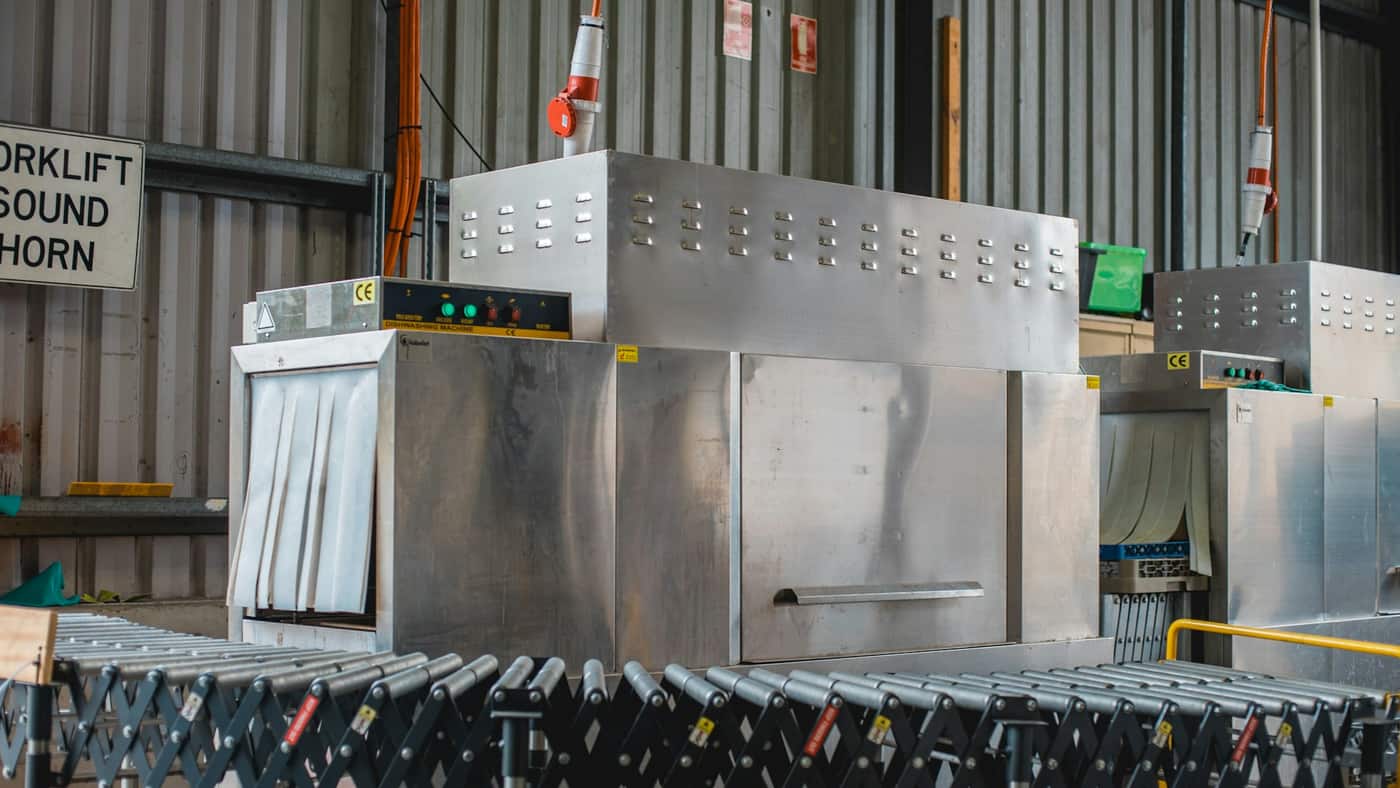
Jackson conveyor machines run racks through wash, power rinse and final rinse zones on a driven conveyor. The conveyor drive motor and gear reducer carry the load, and a slip clutch or overload protects them when a rack jams. Curtains tear and let spray and steam out. Scrap screens and the pump suction strainer clog with food. Rack-sensing switches and photo or limit controls start and stop the rinse, so a failed sensor leaves the machine rinsing continuously or not at all. The tank fill and drain assemblies are the part that fails when a machine will not fill or hold water.
Finding the model and serial plate
The data plate is on the machine, usually on the side or front panel near the controls. It gives the model, serial number, electrical rating and the required final rinse temperature and flow pressure. Read the full model number, not just the series name. Tell us whether it is a door-type or conveyor machine, which booster heater feeds it, and what the rinse gauge reads when the machine rinses.
Parts
Jackson parts are sourced through the manufacturer and its distribution network, and pumps, heaters, solenoids and control boards are model specific. Wear parts such as door seals, curtains, wash arms and end caps are available in OEM and aftermarket forms. We match the part to the serial number and recommend the OEM part where a seal or heater fit affects water temperature or leakage. Lead times for boards depend on the model and supplier.
Manufacturer warranty
If this equipment is still under the manufacturer's warranty, it should usually go through the manufacturer's authorized service network first. We are an independent company and not the manufacturer.
See also
Same owner
More warewashing brands
Jackson repair questions
What rinse temperature does a Jackson machine need?
A hot-water sanitizing machine must reach the final rinse temperature stated on its data plate at the rinse manifold, and the FDA Food Code sets the sanitizing temperature for hot-water machines. Read the temperature gauge or a thermometer during the rinse, not between cycles, because the reading only counts while water flows.
Why does my Jackson machine not fill with water?
Common causes are a closed supply valve, a clogged fill solenoid screen, a stuck door or tank sensor, or a drain left open. Check that the supply valve is open and that the drain stopper is seated. If it still does not fill, the solenoid or float needs service.
Do I need a booster heater with a Jackson machine?
Most high-temperature machines need incoming hot water at a set temperature plus a booster to raise the final rinse. Some models carry an integral booster and some use a separate one. The data plate and manual state the incoming water temperature the machine expects.
Why are my glasses cloudy after a Jackson cycle?
Cloudy glassware usually comes from hard water scale, too much detergent, or a rinse additive that is not feeding. Scaled rinse nozzles also leave streaks. If descaling and a detergent check do not fix it, the rinse feed or booster temperature is the next place to look.
What should I check before calling for a Jackson conveyor that stopped?
Look for a jammed rack or a dish stuck in the curtains, and check the machine's breaker and any overload reset visible on the outside. Do not reach into the machine while it is powered. If the rack is clear and the drive still will not run, the motor, clutch or control needs a technician.