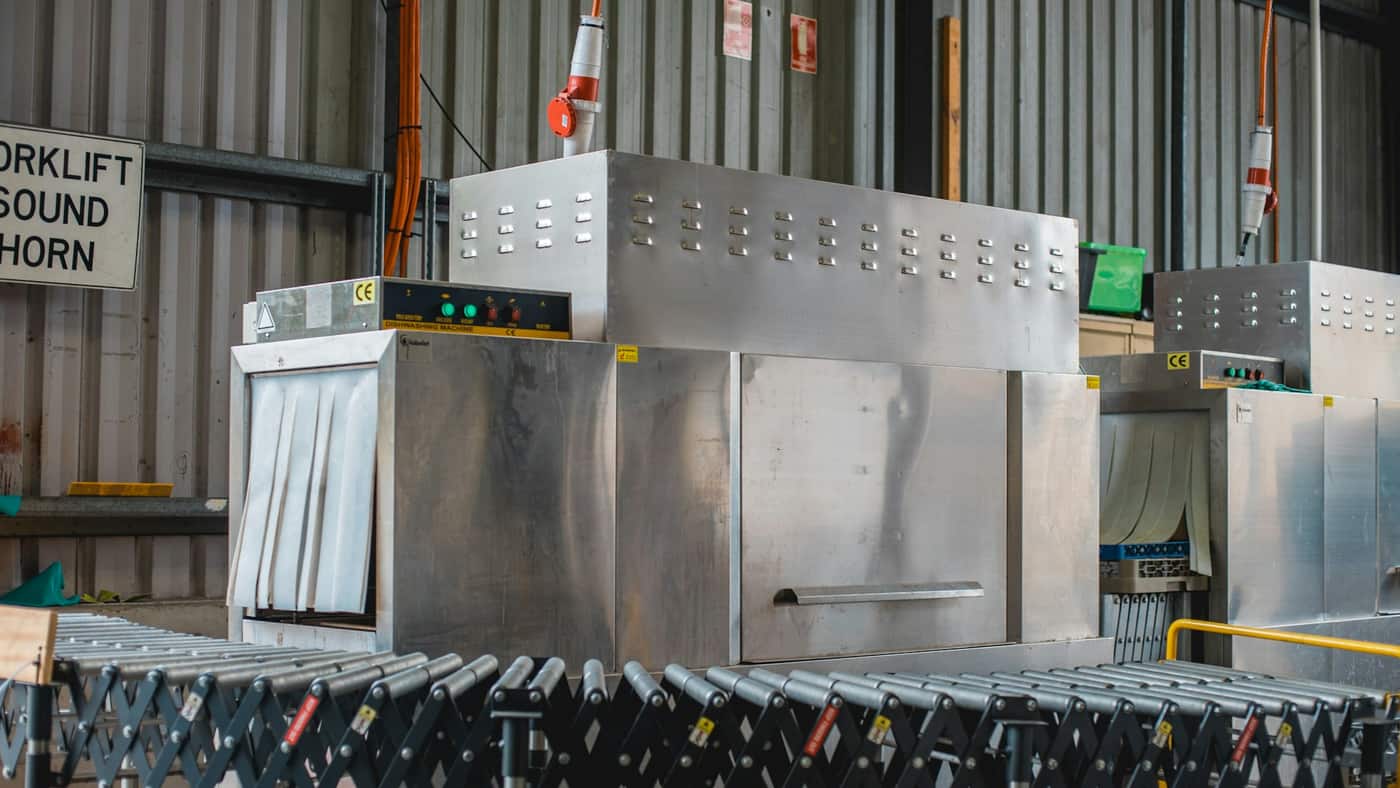
Commercial dishwasher not draining: causes and what to check
Why a commercial dishwasher will not drain or leaves water in the tank: strainers, standpipes, drain lines, solenoids and pumps, and who fixes each.
Why is my commercial dishwasher not draining?
Most commercial dishwashers that will not drain have a clogged scrap screen or strainer, a standpipe or overflow tube not seated, a blocked drain line or floor sink, or a failed drain valve, solenoid or pump. Staff can clear screens and check the floor drain. Plumbing and electrical faults need a technician.
How does each type of dish machine drain, and why does that matter?
Door-type and conveyor machines usually drain by gravity through a standpipe or overflow tube in the wash tank. Lifting the tube or opening a drain valve lets the tank empty into a floor sink or drain. Many door-type models have an electrically operated drain, either a solenoid-driven valve or a motorized actuator, which opens at the end of the shift or when you run a drain cycle.
Undercounter machines and glasswashers often use a drain pump to move water up and out to a standpipe or a sink. A pump can lose prime, jam on a bottle cap or fail electrically. Which type you have decides whether to look for a mechanical obstruction, a plumbing backup or an electrical fault.
The first diagnostic question is simple: does the water level in the machine fall at all? A slow drain points to a partial obstruction. No drain at all points to a stuck valve, a failed pump or a full backup downstream.
What can staff safely check and clear?
Begin with what is visible in the tank. Pull the scrap trays and the strainer baskets. Food, toothpicks, napkins and broken glass collect in them and restrict the drain. Seat the overflow tube or standpipe fully, since one that sits slightly proud keeps the drain partly closed.
Next look beyond the machine. A floor sink that is full of standing water is a backup, and the machine cannot drain into it. Run water in a neighboring sink and watch whether the floor drain gurgles. A grease-clogged line serving the dish area will often show up in several fixtures, not just the dishwasher.
Check the air gap or drain connection for a kink and confirm the drain hose is not crushed behind the machine. All of these are done with the machine off and the power disconnected where needed. If rinsing the screens does not help, the obstruction is further along the line, or the machine's own drain hardware has failed.
What mechanical and electrical parts fail?
On machines with a powered drain, the solenoid or actuator can burn out, stick with scale or lose its seal. A drain valve that does not fully open or close leaves water standing or slowly bleeding the tank. Mineral scale is a frequent cause in hard-water areas, and Hobart, Jackson and Champion machines all depend on clean valve seats.
Drain pumps fail through worn impellers, jammed debris, failed seals or a dead motor. A pump that hums with no flow is usually blocked or seized. A pump that is silent is electrical: no power, a bad float switch or relay, or a control that is not calling for a drain.
Float switches and water level controls matter too. A float stuck with scale tells the control the tank is empty or full when it is not, so the machine may refuse to start a cycle or may refuse to drain. These parts live in water, under power, and they belong to a technician doing commercial dishwasher repair.
Why does it matter beyond a messy floor?
A machine that does not drain properly cannot be relied on to sanitize. Dirty tank water carries food soil into the rinse, and the wash temperature or chemical concentration may not hold. Your health inspector checks final rinse temperature or sanitizer concentration, and dirty water makes both harder to maintain.
A machine that holds standing water also grows a film inside the tank and lines. It smells, and it corrodes parts. In a facility with limited space, a backed-up dish machine can stop the whole line, since there is no other place to wash pans and plates.
Which cause matches which symptom?
Treat a drainage problem as a food safety issue as well as a plumbing one. Have the model plate ready when you call; our guide to finding a commercial equipment model number shows where it is. The table summarizes the common causes.
| Symptom | Likely cause | Who fixes it |
|---|---|---|
| Water level falls slowly | Clogged scrap screen or strainer, partial drain line blockage | Staff clear screens; plumber or technician for the line |
| Water will not leave the tank | Standpipe or overflow tube not seated, stuck drain valve | Staff reseat tube; technician for the valve |
| Water backs up into the floor sink | Blocked building drain or grease line | Plumber |
| Pump hums, no flow | Jammed or worn impeller, blocked hose | Technician |
| Nothing happens when drain is selected | Failed solenoid, actuator, relay or control | Technician |
| Machine will not fill or start | Float or level control stuck with scale | Technician |
| Drains but smells and leaves residue | Scale, soil film, dirty tank | Staff clean per manual; technician for scale in parts |
A safe sequence to follow
Turn the machine off
Disconnect power per the manufacturer's instructions before reaching into the tank or behind the machine.
Pull and clean the screens
Remove scrap trays and strainer baskets and clear food, paper and broken glass.
Seat the standpipe
Make sure the overflow tube or drain plug is fully down, not sitting slightly open or off its seat.
Check the floor sink
Look for standing water or slow drainage in the floor sink or drain receiving the machine.
Look at the hose
Check that the drain hose or line is not kinked, crushed or pushed too far into the receiving drain.
Note the failure pattern
Write down whether it drains slowly, not at all, or only on some cycles, and call.
When to stop and call
- Water remains in the tank after the screens and standpipe are clear.
- The drain pump hums or runs without moving water, or makes no sound at all.
- Several fixtures in the dish area drain slowly, pointing to a building drain or grease line.
- Water leaks from the machine base, a drain fitting or a solenoid.
- The machine drains but will not complete a wash cycle.
Questions about this problem
Why does my dishwasher drain slowly only on busy days?
Busy days push more food soil into the scrap trays and strainers. If they are not emptied between loads, they restrict flow. A partly blocked line may handle light use and struggle under heavy use.
Can a dishwasher drain problem cause health inspection issues?
It can. Dirty tank water makes it harder to hold the final rinse temperature or sanitizer concentration your inspector checks. A machine that cannot drain and refill properly should be corrected before it is used.
Should I pour drain cleaner into the dish machine?
No. Chemical drain cleaners can damage seals, scale-covered valves and pump parts, and are dangerous around dishwashing chemicals. Mechanical clearing of screens and lines is safer and does not risk residue on dishes. Clearing the line mechanically is safer for your dishes.
Does water hardness affect draining?
Yes. Scale builds on float switches, solenoid seats and valves, and sticks them. Many Twin Cities suburbs have hard water, so descaling per the manufacturer's instructions helps drain parts last. Both parts are tested quickly by a technician.
What about an undercounter machine that drains into a sink?
Check the hose for a loop or kink first, because the pump must lift water to the sink. A drain hose that sags below its high loop can siphon or hold water. A technician checks pump and float.