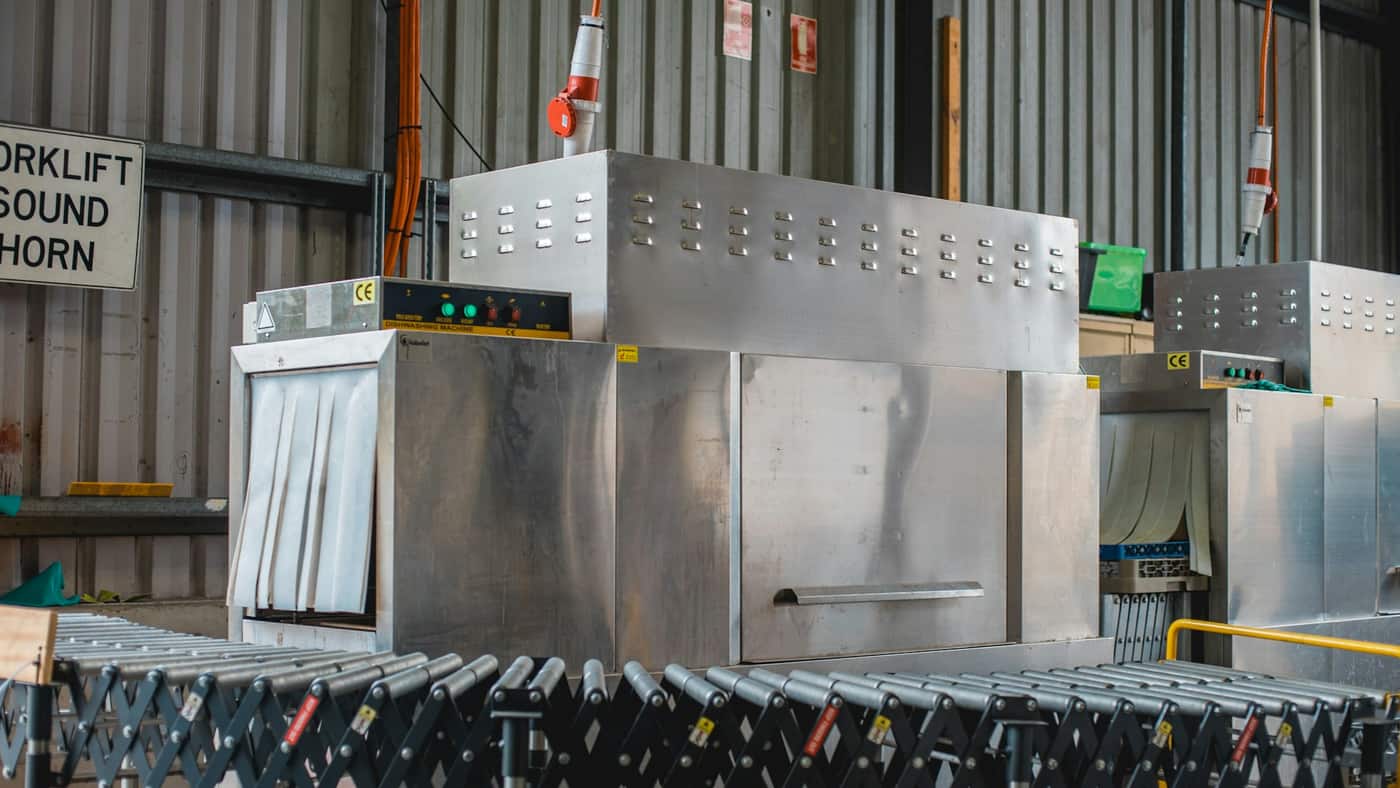
Salvajor disposer and scrap collector repair in the Twin Cities
Salvajor commercial garbage disposer and scrap collector repair in Minneapolis and St. Paul: motors, shredder rings, seals, water controls and jams.
What fails most often on Salvajor disposers?
Jams from bones, silverware and foreign objects, worn shredder components, failed shaft seals leaking into the motor, and water control faults cause most calls. A disposer that hums and does not turn is jammed or has a failed motor capacitor or start circuit. A leak under the motor means the seal has failed.
About Salvajor equipment
Salvajor makes commercial garbage disposers and scrap collection systems for dish rooms, and its units sit under the scrap trough or in the pre-rinse area of school, hospital, hotel, restaurant and institutional kitchens. Unlike a dishmachine, a disposer is a motor and a grinding chamber, so the work is mechanical and electrical, and the water supply that carries waste out is part of the system. A disposer that jams in the middle of a meal period backs up the whole pre-rinse station.
Disposers are blamed for drain trouble that begins elsewhere. A kitchen drain line with grease build-up, or a sewer that the building cannot clear, makes a disposer look faulty. We separate the machine from the plumbing before we pull anything. This page is about the equipment itself, the same commercial garbage disposal service that sits beside our commercial dishwasher repair work in the dish room.
Salvajor disposers
Equipment guide
Seen on this line: Jam from silverware, bones or a pad / Motor overload tripped after a jam / Shaft seal leaking below the motor / Shredder parts worn and grinding poorly
A Salvajor disposer spins a shredding assembly against a stationary ring to reduce food waste, driven by a motor in the range from fractions of a horsepower to several horsepower on heavier units. The failure is usually a jam: a spoon, a bone or a pan scrubber wedged between the swivel impellers and the ring. A tripped motor overload follows. The shaft seal keeps water out of the motor, and when it fails the motor takes on water and the bearings or windings fail. Shredder parts wear with use and chew less efficiently, so the disposer slows and the drain backs up.
Salvajor scrap collectors and troughs
Equipment guide
Seen on this line: Trough nozzles scaled, flow weak / Water solenoid stuck open or closed / Scraps pooling in the trough
A scrap collector uses a trough with a high-velocity water flow that carries scraps to the disposer or to a collection point. The water solenoid, the nozzle holes and the trough itself take the abuse, and the trough is only as good as the pressure behind it. Mineral deposits partly block the nozzles, the water flow weakens, and food sits in the trough instead of moving. A solenoid that sticks open wastes water, while one that sticks closed leaves the trough dry and the disposer overheating on a dry run.
Disposers in the warewashing line
Equipment guide
Seen on this line: Scraps reaching the dishmachine screens / Pre-rinse flow shared with the disposer circuit
Many Salvajor units feed from the pre-rinse table ahead of the dishmachine. When the disposer fails, staff start scraping into the sink or onto the machine's scrap screens instead, which loads the dishmachine pump strainer and the drain with food it was never meant to carry. A disposer fault can therefore appear as a dishmachine fault, with slow drains, a clogged pump screen and standing water in the tub. We check the disposer and the pre-rinse flow before blaming the machine.
Finding the model and serial plate
The nameplate is on the motor housing or control box, and gives the model, serial number, horsepower, voltage and phase. Write down the horsepower and the model before you call, because motors, shredder parts and seals are matched to them. Tell us whether the unit hums, trips the breaker or leaks, and whether it runs with the water on or off.
Parts
Disposer wear parts such as shredder components, seals, bearings and water solenoids are available through the manufacturer and its dealers, with some interchangeable aftermarket choices. Motors and control panels are matched to horsepower, voltage and phase. A disposer with a failed seal that took in water often needs a motor, so we price the rebuild against replacement before you commit.
Manufacturer warranty
If this equipment is still under the manufacturer's warranty, it should usually go through the manufacturer's authorized service network first. We are an independent company and not the manufacturer.
See also
Compared with
More warewashing brands
Salvajor repair questions
Why does my disposer hum but not spin?
A humming disposer is jammed or has lost its starting circuit. A foreign object wedged against the shredder ring is the usual cause. Switch it off at the breaker before you touch anything, and never reach into the chamber. If it will not turn after the jam is cleared, the motor needs testing.
Should the water run while the disposer is on?
Yes. The water flushes waste through the drain and keeps the seal and chamber cool and clean. Running a disposer dry shortens its life. A solenoid or water control that stops delivering water means the disposer should not be used until it is fixed.
Why is there water under the motor?
A leak below the motor usually means the shaft seal has failed and water is working into the motor. Stop using the disposer and call, because a wet motor can short or seize. Replacing a seal early costs less than replacing a motor.
Is a slow drain a disposer problem?
Not always. A slow drain after the disposer can be a grease-clogged line, an undersized pipe or a blocked grease interceptor. If the disposer runs freely and the trough still backs up, the plumbing is the first place to look, and that is outside our scope.
What should never go into a commercial disposer?
Silverware, bones above the unit's rating, aluminum foil, plastic wrap, glass and stringy fibrous waste cause most jams. Grease also coats the drain downstream. A scrap catch at the pre-rinse station keeps most of it out.