
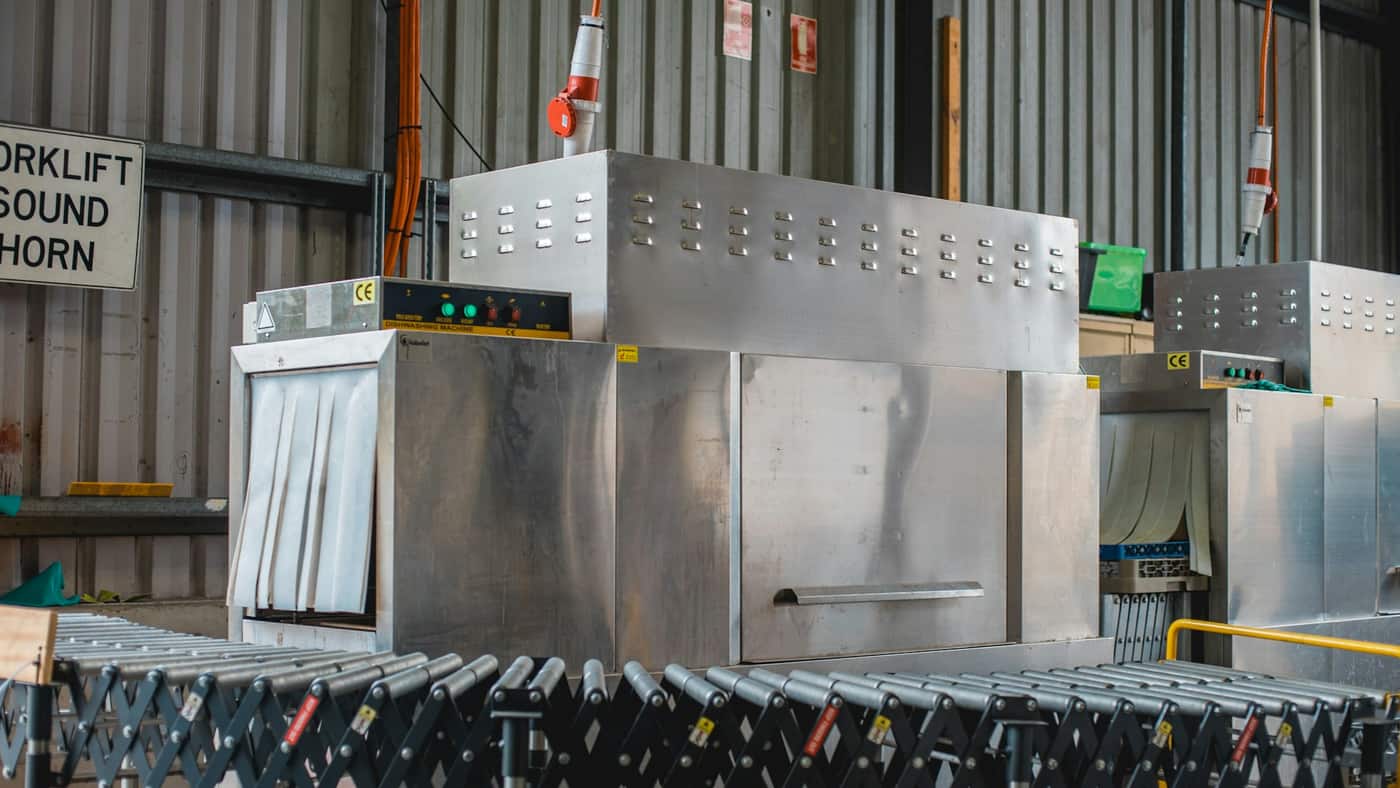
Commercial dishwasher maintenance and deliming in Minneapolis and St. Paul
Planned dish machine maintenance: deliming, wash and rinse arms, booster heater scale, chemical tubing, and final rinse temperature and pressure checks.
How often does a commercial dishwasher need deliming?
Hobart says the frequency depends on water hardness, water temperature and how much water the machine uses each day, so no single calendar date fits every kitchen. Minneapolis and Saint Paul both publish hardness near 5.7 to 5.8 grains per gallon. Your machine manual and chemical supplier set the procedure and the interval.
What a commercial dishwasher visit involves
A dish machine heats water, sprays it through narrow nozzles and then holds a final rinse at a set temperature or chemical strength. Hard water leaves scale on all of that. Scale clogs the rinse nozzles, coats the tank and booster elements, and leaves a chalky film on glasses. A planned visit looks at the whole path: the delime, the arms, the screens and curtains, the chemical feed, and the temperature and pressure readings that prove the machine sanitizes. When it already fails to wash or drain, that is commercial dishwasher repair.
This page covers door-type, conveyor and undercounter machines, and the booster heater behind high-temperature models. Bar glasswashers follow the same logic and have their own page at glasswasher repair. Water that scales a dish machine also scales ice makers; that side is covered in ice machine cleaning and sanitizing. Below you will find what a visit finds, what you should do beforehand, how long the machine is out of use and where maintenance ends.
What a commercial dishwasher visit covers
- Door-type (hood) machines
Racks go in by hand, so the visit focuses on the wash tank screen, the lower scrap screen, the spray arms and the line strainer. Hobart's AM14 manual lists a clogged line strainer as a cause of no rinse.
- Conveyor machines
These add curtains, a conveyor drive and long rinse and wash manifolds. Torn curtains and scaled rinse heads are the usual finds, and the tank is large enough that a delime takes real planning.
- Undercounter machines
Scrap screens, small wash arms and tank elements are all within reach. A Parts Town cleaning guide for Champion machines tells owners to flush and back-flush the screen, and describes removing scale from heating elements and probes with a stainless scouring pad, never steel wool, which is technician work inside the machine.
- High-temperature machines with a booster heater
The final rinse must reach its set temperature at the manifold. Hobart's AM14 manual lists lime on the booster's heating elements as a reason elements keep burning out.
- Low-temperature chemical-sanitizing machines
Chemical feeder pumps, squeeze tubing and sanitizer strength are the center of the visit. One Jackson glasswasher manual lists a minimum of 50 ppm chlorine and minimum wash and rinse temperatures of 120°F, with 140°F recommended.
- Glass rinsers and bar glasswashers
Scale shows first as streaks and spotting on glassware, and Jackson's troubleshooting chart lists limed-up rinse heads as the reason little water comes through the rinse assemblies.
What the visit finds and what we do about it
| Finding | Why it develops | What is done |
|---|---|---|
| Lime on rinse nozzles and arm end caps | Heated hard water leaves calcium and magnesium behind. The narrow arm and rinse-nozzle openings are where it shows first. Hobart notes that scale makes pumps work harder and that how often to delime depends on hardness, water temperature and daily water use. | With the machine off at its switch and drained, arms and end caps come off and are flushed. A Parts Town cleaning guide for Champion machines says to clear the final rinse nozzles with a straightened paper clip and to check them daily for mineral deposits. Stubborn scale is delimed by a technician or the chemical supplier. |
| Scale on tank heating elements and probes | A heating element under a crust of scale runs hotter than it should, and a probe coated in scale reads late. Both shorten the life of the part. | The machine is delimed by the maker's procedure. The same Parts Town guide describes taking build-up off elements and probes with a stainless scouring pad and never using steel wool; with the machine off and drained, that is a technician's job. |
| Booster heater elements coated with lime | Hobart's AM14 manual names lime on the booster elements as a reason they burn out repeatedly, and a heater that sits idle for hours then operates may trip its limit switch or open its relief valve. | Booster work involves high voltage and plumbing, so it belongs to a technician. The visit checks elements, the relief valve and the limit switch, and replaces what has failed. |
| Final rinse below the number on the data plate | For hot-water sanitizing, Minn. R. 4626.0795 requires the fresh rinse at the manifold to be at least 180°F, or 165°F for a stationary-rack, single-temperature machine, and no higher than 194°F. Minn. R. 4626.0905 separately requires the ware surface to reach 160°F, measured with an irreversible registering temperature indicator. Low incoming water, a failing booster or low pressure can all pull the rinse down. | The gauge is checked against a reference thermometer, then incoming temperature, booster operation and rinse pressure are tested in turn. A low rinse is the subject of the low rinse temperature guide. |
| Flow pressure outside the range | Minn. R. 4626.0800 requires flow pressure within the range on the data plate and between 5 and 30 psi. Hobart's AM14 door-type manual puts it at 20 to 25 psi with the rinse valve open and lists a clogged line strainer or a misadjusted regulator as causes of no rinse. Static pressure with the valve closed reads differently and can mislead. | The strainer is cleaned, the regulator set and pressure read while the rinse valve is open. Each machine's data plate gives its own range. |
| Chemical tubing hard, cracked or flattened | Peristaltic pumps squeeze their tubing on every dose, so it fatigues. Jackson lists squeeze tubes among wear items, and a pump delivering less chemical than set leaves spots, film or weak sanitizer. | Tubing is replaced on a schedule, tube inlets are confirmed to sit in the right containers and pumps are primed. Sanitizer strength is checked with test strips afterward. |
| Curtains torn, scrap screens packed | Curtains and screens wear and clog. Jackson's warranty lists curtains and drain balls as wear items, and the Parts Town guide for Champion machines tells operators to flush scrap screens until clean without striking them on hard surfaces. | Torn curtains are replaced so steam and spray stay in the machine. Screens are cleaned and, where bent or split, replaced. |
| Wash arms that do not spin or leak at the manifold | Arm bearings wear and manifold O-rings flatten. The Parts Town guide for Champion machines says arms that will not rotate may need new bearings and that the manifold O-ring should be checked. | Bearings and O-rings are replaced. The arm is spun by hand after reassembly to confirm it turns freely. |
| Water harder than the maker assumes | One Jackson model's warranty terms call for water hardness lower than 3.0 grains per gallon, pH between 7.0 and 8.5 and under 250 ppm dissolved solids. Minneapolis reported 5.8 grains per gallon in January 2026 and Saint Paul 5.67 in August 2026. | The finding is recorded and the delime interval shortened. Water treatment is a building decision for a water-treatment supplier and your chemical vendor. |
Before the visit
- Write down the date of the last delime and which product and procedure were used. Hobart warns that improper deliming can hurt the machine, so the history matters.
- Run the normal end-of-day clean first: turn the machine off at its switch, drain the tank, then empty and flush the scrap screens and pull the arms. The technician should meet scale, not food.
- Note whether the machine is high-temperature or chemical-sanitizing, and find the data plate behind the door so its temperature and pressure numbers are readable.
- Record wash and final rinse gauge readings at mid-cycle on a few shifts, and what the sanitizer test strips showed on chemical machines.
- Collect your chemical supplier's name and the product labels, since the delimer and its dilution come from them.
Stop at gas valves, 208, 240 or 480 volt wiring, sealed refrigerant circuits, steam under pressure and anything live. Those are a call.
How long the equipment is out of use
A delime takes the machine out of service for more than the cycle. Jackson's procedure on one model is to add the delimer, run the supplier's recommended time, wait five minutes, inspect and repeat if needed, then run two cycles to clear the residue. After that the tank must refill and heat before wares go through, and the final rinse should read its data-plate value first. Have a plan for the dish pit during that window, and plan the visit after the last rack of the day where possible.
Between visits
- Every day, turn the machine off at its switch and drain it, then flush the scrap screens, pull the wash and rinse arms and end caps and clear the final rinse nozzles with a straightened paper clip, as the Parts Town guide for Champion machines describes.
- Read the wash and final rinse gauges every shift against the data plate and log them. The Minnesota numbers for hot-water sanitizing are 180°F at the manifold (165°F for single-temperature stationary-rack machines), no higher than 194°F, and 160°F at the ware surface.
- On chemical machines, test sanitizer strength with strips and top up chemical containers before they run dry. One Jackson model lists 50 ppm as its minimum chlorine.
- Delime when scale shows, using the delimer and procedure in the machine's manual, and follow the delimer label's handling and PPE cautions. Jackson says frequency depends on water conditions. Anything past the daily cleaning is the technician's or the chemical supplier's job.
- Report stiff or cracked chemical tubing and torn curtains early so a technician can replace them, and never use steel wool inside the machine.
When maintenance is not enough
Deliming and cleaning cannot restore a tank that has rusted through, a wash pump that leaks at the shaft, or heating elements that keep failing after the machine has been descaled. If a booster or tank element burns out repeatedly on a delimed machine, the cause is voltage, thermostat or water supply rather than scale, and that moves the work to repair. A machine with chronic leaks and corroded panels may be near the end of its life, which is a replacement conversation, and pump, heater and door problems belong to repair, not a maintenance visit.
Commercial dishwashers by brand
Related to commercial dishwasher
Repairs for this equipment
Where it matters most
Where we service commercial dishwashers
- Commercial dishwasher service in Chanhassen, MN
- Commercial dishwasher service in Chaska, MN
- Commercial dishwasher service in Columbia Heights, MN
- Commercial dishwasher service in Coon Rapids, MN
- Commercial dishwasher service in Cottage Grove, MN
- Commercial dishwasher service in Crystal, MN
- Commercial dishwasher service in Eagan, MN
- Commercial dishwasher service in Eden Prairie, MN
- Commercial dishwasher service in Edina, MN
- Commercial dishwasher service in Elk River, MN
- Commercial dishwasher service in Farmington, MN
- Commercial dishwasher service in Forest Lake, MN
Other maintenance and cleaning visits
Questions about commercial dishwashers
How hard is Minneapolis and Saint Paul water for a dish machine?
Minneapolis Water Works listed total hardness at 5.8 grains per gallon in its January 2026 plant analysis, and Saint Paul Regional Water Services listed 5.67 in August 2026. Other Twin Cities suburbs draw on different supplies, so check your own utility's report. Both figures exceed the 3.0 grain limit in one Jackson model's warranty terms.
What actually happens during a delime cycle?
Hobart describes an acidic deliming chemical added to the wash water and circulated through the machine, with a little heat applied early, then draining and a fresh-water rinse. Jackson's glasswasher procedure adds running the supplier's time, inspecting, and two cycles afterward to clear residue.
Why do final rinse nozzles get a paper clip?
A Parts Town cleaning guide for Champion machines says to check final rinse nozzles for mineral deposits daily and, at end of day, to clean them with a small straightened paper clip, with the machine off. Rinse nozzles are the narrowest water path in the machine, so they clog first and spotting follows.
Which temperature matters for sanitizing on a high-temperature machine?
Minn. R. 4626.0795 covers the fresh rinse entering the manifold: at least 180°F, or 165°F for a stationary-rack, single-temperature machine, and no more than 194°F. The wash tank has lower minimums by machine type under part 4626.0785, from 150°F for dual-temperature machines to 165°F for stationary-rack single-temperature; one Hobart AM14 manual lists 150 to 160°F.
How does maintenance differ on a chemical-sanitizing machine?
The chemical feed becomes the main wear item. Jackson lists squeeze tubes among wear parts, requires its tube inlets to sit in the proper containers and says pumps need priming after install. One Jackson model lists a minimum 50 ppm chlorine and a 120°F minimum wash and rinse temperature, with 140°F recommended.
Can I scrub scale off with steel wool or a scouring pad?
A Parts Town cleaning guide for Champion machines describes a stainless scouring pad, never steel wool, for scale on elements and probes. Those parts are inside the machine, so that is technician work; staff stay with the daily clean, and for general scale a delime cycle with your supplier's product is the safer route.
Sources
- Minneapolis Water Works: Monthly Plant Effluent Water Analysis, January 2026
- Saint Paul Regional Water Services: monthly water quality report, August 2026
- Hobart: dealing with lime scale build-up
- Hobart AM14 customer maintenance manual: flow pressure, booster, troubleshooting
- Jackson Delta 5-E installation, operation and service manual (Rev. L): delime procedure, chlorine minimum, wear items, warranty water limits
- Parts Town: Champion dishwasher cleaning guide (a Parts Town article, not a Champion document)
- Minnesota Rules 4626.0795: mechanical warewashing, hot water sanitization temperatures
- Minnesota Rules 4626.0785: wash temperatures by machine type
- Minnesota Rules 4626.0800: flow pressure
- Minnesota Rules 4626.0905: ware surface temperature, irreversible registering indicator