
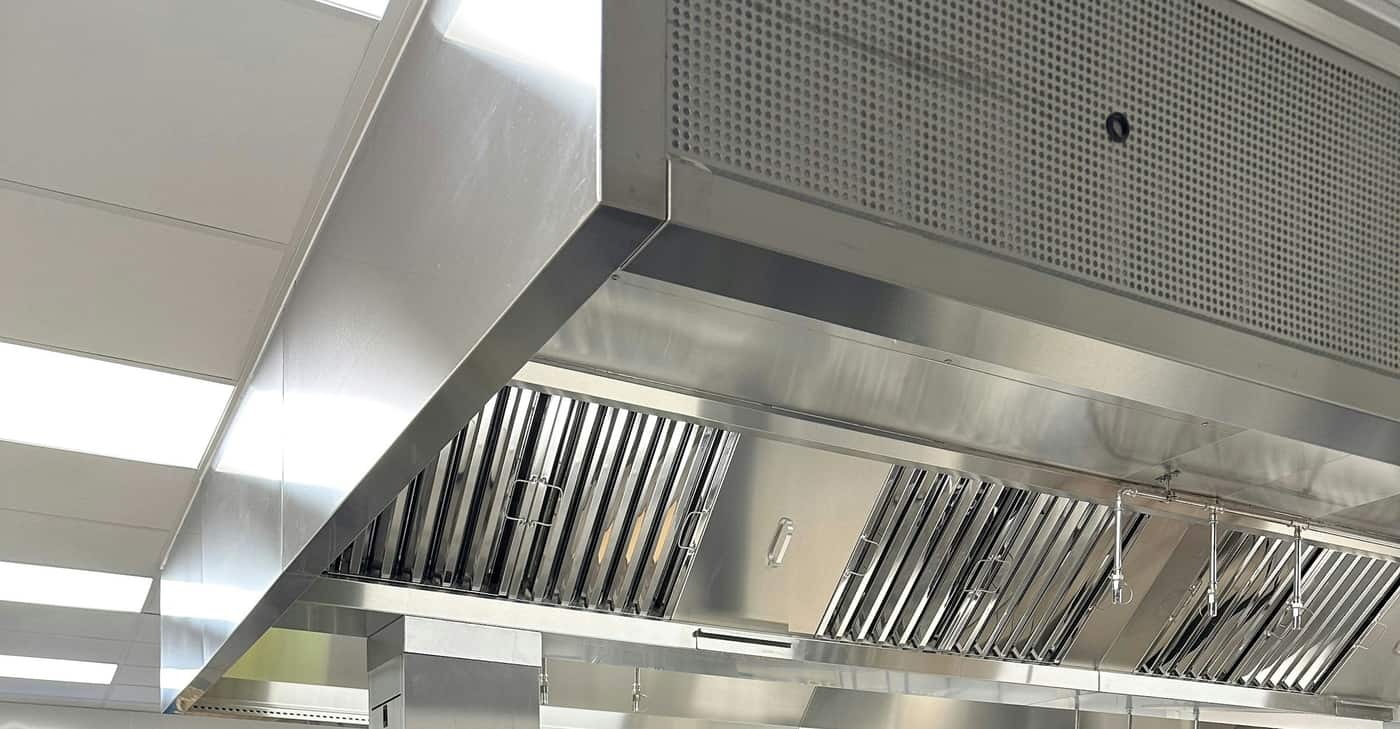
Smoke rolling out from under the hood: isolate the fan, the filters and the make-up air
Smoke rolling out from under the hood: a step-by-step isolation with observations that separate the exhaust fan, the filters and the make-up air.
Smoke rolls out from under my hood: is it the fan, the filters or the make-up air?
Change one variable at a time. Note where and when smoke escapes, compare the hood with make-up air on and off, then compare clean filters with loaded ones. A draw that does not change with make-up air points at the exhaust side. A draw that does points at the room. Better capture with clean filters points at loading.
Where does the smoke escape, and when does it start?
Before any test, look at the spill itself, because its shape already narrows the list. Smoke that leaves along the whole front edge of the hood suggests the exhaust as a whole is short of air. Smoke that leaves at one end suggests a draft crossing the hood from a door, a pass-through or a make-up air register aimed at the line. Smoke that comes from one appliance only suggests a load problem at that appliance, such as a burner running rich or a fryer with a flame that is not right, and the commercial fryer repair page is where those are covered.
Timing sorts it further. A hood that fails only when every burner and fryer is lit has a thin margin and a weak link somewhere. A hood that failed on a particular day points at an event, such as a belt that broke, electrical work on the roof or a filter change. A hood that fails only on the coldest mornings points at make-up air that shuts itself down in cold weather. One that is weak from the first minute of the day is a steady restriction, not a load problem.
Write the spill location, the time it began and the appliances that were running. That record turns three physical tests into a diagnosis, and it is the same record a technician starts from. What the technician repairs once the weak part is found is on the hood and ventilation service page.
Test one: does the draw change when make-up air is on or off?
The kitchen exhausts air and the make-up air unit replaces it, so a short supply starves the exhaust fan even when the fan is healthy. CaptiveAire's troubleshooting guidance lists the two as separate problems with separate checks, which is the reason to separate them here. With the line running and smoke spilling, note how the hood behaves. Then, at its own switch, turn the make-up air off for a minute and watch. Then turn it back on.
Read the result. If capture gets noticeably worse with make-up air off, and better with it on, the exhaust fan is moving air and the room is the limit. If doors that were pulling inward ease when make-up air comes on, the room had gone negative. If nothing changes either way, the make-up air is not the main factor, or it was not delivering in the first place; a unit that is switched on but pushing nothing needs a technician to read its damper, filters and fan. If capture is poor with make-up air on and the make-up air unit is silent, the unit is off or locked out.
A direct-fired make-up air unit that lights in a sequence can lock out on a flame or freeze safeguard, and a lockout is the unit protecting itself, not something to reset repeatedly. A unit that locked out on a cold morning and runs fine later in the day fits a pattern worth reporting. Some hood and fan units are also armed by a fire system distributor before the fan will run; CaptiveAire notes that an unarmed unit can keep the fan off. The fire suppression system itself is the fire protection contractor's work.
Test two: is the exhaust fan delivering what it should?
If make-up air made no difference, look at the exhaust fan. The first question is whether it is running and which way it turns. CaptiveAire's manual says reversed rotation will result in poor air performance, motor overloading and possible burnout, and its troubleshooting chart lists incorrect fan rotation under insufficient airflow. Three-phase motors reverse when any two power leads are interchanged, so a hood that went weak right after electrical work or a motor replacement is a prime suspect. The fan still spins and makes noise but moves much less air.
Other signs sort the fan itself. No sound at all with the switch on points to the disconnect, the breaker or the starter; CaptiveAire's troubleshooting adds that on 208V three-phase fans the starter may have a reset. A motor that runs with little air movement and a rubber smell points at a belt. The manual calls for belt tension to be checked after the first two weeks and quarterly after that, lists loose, worn, oily or misaligned belts among the causes of vibration and noise, and warns that over-tightening wears the bearings. A fan that cuts out when the kitchen is hot is an overload: the manual says that if measured amps exceed the nameplate FLA rating, fan RPM must be reduced, and its cycling list includes motor amperage above FLA and a fan sitting near a rooftop heat source.
Everything on this list lives on the roof or in the electrical panel. A crew's part is limited to noting what it hears and smells and reporting whether the problem started after electrical work. Climbing to the fan, opening a motor or swapping leads belongs to a technician. The roof fan's grease drain and the hood interior are a hood cleaning company's work, to NFPA 96.
Test three: are the filters or the duct restricting the air?
Filters are the cheapest variable to change, so change them. With the appliances under the hood turned off and the filters cool enough to handle, swap in a clean set of filters, seated in the right direction, then relight the line and compare. If capture improves a lot, the old filters were loaded and a cleaning interval is overdue. CaptiveAire's hood maintenance guidance is to clean baffle grease filters daily, in a dish machine or a soak sink, and to reinstall them with the airflow in the direction marked on the filter. Its troubleshooting also lists missing filters, and a missing filter leaves an open path that bypasses the capture pattern and lets grease into the plenum and duct.
If clean filters make no difference, the restriction is downstream. CaptiveAire's list for no exhaust includes square elbows, an excessive number of elbows and leaks in the ductwork. Those are design or damage problems that a technician or the hood supplier addresses, and not something to fix with a screwdriver. Grease buildup inside the duct is a hood cleaning company's work.
Do not leave filters out to get more airflow, and do not turn the fan faster to compensate. A faster fan can overload the motor and trip it, and it also changes the balance with the make-up air.
| Isolation result | What it points to | Who fixes it |
|---|---|---|
| Capture worse with make-up air off, better with it on | Room negative; make-up air short or intermittent | Technician for the make-up air unit; crew reports lockouts |
| No change with make-up air on or off, no fan sound | Fan not running: disconnect, breaker, starter or controls | Technician or electrician |
| Weak since electrical work, fan spins and makes noise | Reversed rotation on a three-phase fan | Technician or electrician |
| Motor runs, little air, belt squeal or rubber smell | Slipping, worn or broken belt; misaligned pulleys | Technician |
| Better with a clean set of filters | Loaded filters; cleaning interval too long | Crew swaps filters with the line off and cool; hood cleaner for the hood and duct |
| Fan quits when the kitchen is hot, restarts later | Motor overload, high amps or heat | Technician |
| Poor capture with clean filters, fan healthy, make-up air healthy | Duct restriction, elbows, leaks or a mismatched fan and hood | Technician or hood supplier |
Where does each test stop?
The three tests above are observation steps that need no panel, no ladder and no tools. They tell you which half of the system to describe when you call. Past that, each answer ends at a different trade. The exhaust fan, its belt, motor and rotation are technician work. The make-up air unit's burner, gas valve and safeguards are technician work. The hood and duct interior belong to a hood cleaning company. Any fire suppression trouble light, discharge or reset belongs to a fire protection contractor.
The isolation record is the useful hand-off. A technician who is told that capture worsens with make-up air off, that the fan runs quietly and that the problem began Monday arrives with a short list instead of a long one. The same record helps if the answer turns out to be an appliance problem and not a ventilation one, since a weak burner and a weak hood look alike from the cook's side of the line. Filter and fan upkeep that prevents repeat problems is in the maintenance checklist.
A safe sequence to follow
Mark where the smoke escapes
Note whether it spills along the whole front, at one end or from one appliance, and which appliances were running.
Compare with make-up air off, then on
At its own switch, turn make-up air off for a minute, then back on, and note how capture and the doors respond.
Listen to the exhaust fan
Note silence, squeal, rumble or rubber smell, and whether the problem began after electrical work.
Swap in clean filters
With the appliances off and the filters cool, install a clean set in the marked airflow direction, then relight the line and compare.
Compare idle with full load
Run the hood with the burners off, then fully lit, and note when capture fails.
Record the result and stop
Write down each observation and hand the list to the technician; do not climb to the roof fan or open any panel.
When to stop and call
- The fan is silent with the switch on and breakers normal, or it runs and moves little air after electrical work
- A belt squeals, smokes or has broken, or the fan shakes or cuts out when hot
- The make-up air unit is off, tripped, frozen or showing a fault
- Capture stays poor after clean filters and a make-up air check
- The fire suppression system has discharged, shows a trouble light or needs resetting, in which case call a fire protection contractor
Questions about this problem
Why did the hood weaken right after the electrician worked on the roof wiring?
A three-phase fan reconnected with two leads swapped turns backward. CaptiveAire's manual says reversed rotation results in poor air performance, motor overloading and possible burnout, and that interchanging any two leads reverses a three-phase motor. Ask the contractor to confirm rotation against the arrow on the fan before the job is closed.
How do I tell a make-up air problem from an exhaust fan problem?
Turn the make-up air off for a minute at its switch and watch. If capture worsens, the exhaust fan is moving air and the room is the limit. If nothing changes and the fan is quiet, suspect the exhaust side. CaptiveAire's troubleshooting treats no make-up air and no exhaust as separate lists with separate checks.
Can I leave a filter out to get more airflow?
No. A missing filter opens a path that bypasses the capture pattern and lets grease into the plenum and duct, where it is a fire hazard. CaptiveAire lists missing filters in its no-exhaust checks. Keep every slot filled with a clean, undamaged filter.
Why can't I just speed the fan up to fix weak capture?
Motor amps limit it. CaptiveAire notes that if measured amps exceed the nameplate FLA rating, fan RPM must come down. A faster fan can overload, trip and stop altogether, and it changes the balance with make-up air. Find the restriction instead.
The hood works until the make-up air cuts out. Is that the fan's fault?
Usually not. Without make-up air the room goes negative and the exhaust fan pulls less, so doors pull shut and flames lean toward the hood. The fault sits in the make-up air unit, its switch, filters, damper or safeguards. The exhaust fan can be perfectly healthy.
Sources
- CaptiveAire troubleshooting: exhaust fan and make-up air not performing
- CaptiveAire exhaust fan installation, operation and maintenance manual
- CaptiveAire hood maintenance: daily baffle filter cleaning
- NFPA 96, Standard for Ventilation Control and Fire Protection of Commercial Cooking Operations (standard listing)